
How to Use Financial Data to Drive Strategic Decisions

10 Financial KPIs Every $3M+ Business Owner Should Track

10 Financial KPIs Every $3M+ Business Owner Should Track

💡Introduction : Most $3M–$25M owners don’t have a KPI problem — they have a priority problem. There are dozens of financial KPIs for small business owners to choose from, but tracking 30 numbers monthly is a recipe for tracking none of them well. This article gives you the 10 that actually move decisions, why each one matters, the formula, and the healthy range to benchmark against.

10 financial KPIs for small business owners

1. Gross Margin %

Formula: (Revenue – COGS) ÷ Revenue

Healthy range: 30–60% for services; 20–40% for product/distribution

What it tells you: Whether your pricing and cost structure is fundamentally sound. Margin compression is the earliest warning of trouble — usually 6–12 months ahead of profitability decline.

2. EBITDA Margin

Formula: EBITDA ÷ Revenue

Healthy range: 10–20% for most owner-led businesses

What it tells you: Real operating profitability before financing and tax decisions. This is the number every buyer, lender, and investor uses to value your business.

3. Operating Cash Flow

Formula: Net income + non-cash items ± changes in working capital

Healthy range: Should track within 80–120% of EBITDA over a rolling 12 months

What it tells you: Whether profit is actually converting to cash. A persistent gap means working capital is leaking somewhere.

4. Current Ratio

Formula: Current Assets ÷ Current Liabilities

Healthy range: 1.5–3.0

What it tells you: Short-term solvency. Below 1.5 means you may struggle to cover the next 12 months of obligations. Above 3.0 may mean cash is sitting idle.

5. Days Sales Outstanding (DSO)

Formula: (AR ÷ Revenue) × 365

Healthy range: 30–45 days for most B2B services

What it tells you: How fast you’re collecting. Every 5-day improvement frees real cash — a $5M business with a 5-day DSO improvement unlocks roughly $68K of working capital.

💰 Improve cash flow without increasing sales
Small improvements in collections, inventory, and vendor payments can free up significant working capital. See how our CFO team helps businesses optimize cash flow.
📞 (602) 832-7070

6. Days Payable Outstanding (DPO)

Formula: (AP ÷ COGS) × 365

Healthy range: 30–60 days

What it tells you: How aggressively you’re using vendor terms. Stretching DPO is free working capital — within reason. Too far and you damage supplier relationships.

7. Cash Conversion Cycle (CCC)

Formula: DSO + DIO – DPO (DIO = Days Inventory Outstanding)

Healthy range: Lower is better; sub-30 days is excellent for services

What it tells you: How long your money is tied up in operations. CCC is the single best diagnostic for working capital efficiency.

8. Customer Concentration

Formula: Top customer % of revenue (and top 5 % of revenue)

Healthy range: No single customer >15%; top 5 <40%

What it tells you: Risk exposure. Buyers and lenders dock valuation hard when concentration is high. Owners often underestimate it until they prepare for a sale.

9. Revenue per Employee

Formula: Revenue ÷ FTE count

Healthy range: $150K–$300K for services; $300K–$600K for tech-enabled

What it tells you: Productivity. Falling revenue per employee in a growth phase usually means you’re hiring ahead of revenue or operationally inefficient.

10. Rolling 12-Month Revenue Growth

Formula: (Trailing 12-mo revenue this period ÷ Trailing 12-mo revenue prior period) – 1

Healthy range: Industry-dependent; 10–25% is healthy for most $3M–$25M businesses

What it tells you: Real growth signal, smoothed for seasonality. Monthly YoY comparisons mislead; rolling 12 doesn’t.

⏳ 📊 How to Actually Use These KPIs

Track all 10 monthly. Build a one-page dashboard. Color-code each: green if in healthy range, yellow if drifting, red if breached. Then — and this is the part most owners skip — write down the decision you’ll make if any KPI hits red. Pre-committed decisions beat reactive ones every time.

❓ Frequently Asked Questions

Which financial KPIs are most important for a $5M services business? ?

Gross margin, operating cash flow, DSO, customer concentration, and rolling 12-month growth. Master those five before adding the other five.

How often should I review financial KPIs?

Monthly review of all 10 in a one-hour finance review. Weekly check-in on cash flow and DSO. Quarterly deep-dive on customer concentration and growth.

What’s the difference between a KPI and a metric?

A KPI is a metric tied to a decision. If a number wouldn’t change your behavior at any threshold, it’s a metric — not a KPI. Cut metrics; keep KPIs.

Should I share KPIs with my team?

Yes — selectively. Operations leaders should own DSO, DPO, gross margin, and revenue per employee. Sales should own customer concentration and growth. Owners should own all 10 at the dashboard level.

✅ Conclusion

The right financial KPIs for small business owners aren’t a long list — they’re the 10 that drive decisions on pricing, hiring, capital, and risk. Build the dashboard, color-code it, pre-commit the decisions, and you’ll catch problems 90 days before they would have caught you.

If you want a CFO to build your KPI dashboard and run the monthly review with your team, book a free discovery call.

👤 About the Author

Ron Elwood is the Founder of CFO For My Business and has built KPI dashboards for 100+ owner-led businesses across the Southwest. Connect with Ron on LinkedIn.


⚡ Ready to make cash flow forecasting work like a CFO?
📞 (602) 832-7070
Gemini_Generated_Image_b0onfxb0onfxb0on

The 13-Week Cash Flow Forecast: A Founder’s Guide to Financial Clarity

13 week cash flow forecast

💡Introduction : If you’ve ever stared at a profitable P&L and a stressed-out bank balance in the same week, you already understand why founders need a 13-week cash flow forecast. Profit is an opinion; cash is a fact. This guide walks through what a 13-week forecast is, why it works better than monthly budgeting, how to build one in an afternoon, and the discipline that turns it into a weapon for growth instead of a Tuesday chore.

📊 What a 13-Week Cash Flow Forecast Actually Is

A 13-week cash flow forecast is a rolling weekly projection of every dollar in and every dollar out of your business for the next quarter. Unlike a monthly budget, it operates on the only timeframe that matters when cash is tight: the next payroll, the next loan payment, the next vendor due date. It uses the direct method — you forecast actual receipts and actual disbursements, not adjusted earnings.

⏳ Why 13 Weeks (Not 8, Not 26)

Thirteen weeks is one full quarter. Long enough to see the next big tax payment, the next debt service date, and seasonality patterns. Short enough that the numbers stay credible — anyone forecasting cash to the dollar 26 weeks out is guessing. Thirteen is the sweet spot finance has used since the 1970s, and it’s the standard turnaround consultants and lenders expect to see.

💰 What Goes In — Inflows

Customer collections — by customer, by week, based on AR aging and historical pay behavior (not invoice date)

  • Other receipts — refunds, deposits, interest, asset sales
  • Financing inflows — line draws, new debt, equity raises (only when committed, not hoped for)

💸 What Goes In — Outflows


    • Payroll & related taxes — by pay date, including 941 deposits
    • AP disbursements — by vendor, by week, based on actual payment terms
    • Recurring fixed costs — rent, software, insurance, utilities
    • Variable costs — COGS, freight, marketing
    • Debt service — principal + interest by due date
    • Tax payments — sales tax, state estimates, federal estimates
    • Owner draws / distributions

🛠️ How to Build It in an Afternoon

  1. Pull a YTD detailed P&L by week from your accounting system.
  2. Open a 13-week template (Excel, Sheets, or a tool like Float, Jirav, or Cashflowtool).
  3. Lay out the weekly cash inflow and outflow rows for the next 13 weeks.
  4. Populate Week 1 from real data — known receipts, known disbursements.
  5. Populate Weeks 2–13 from contractual obligations + historical timing.
  6. Reconcile the model to your current bank balance.
  7. Review weekly. The first 4 weeks will be sharp; weeks 8–13 will be directional.

📈 The Variance Discipline That Drives Behavior

A forecast you don’t review is just a spreadsheet. The discipline that makes the 13-week forecast actually work is the weekly variance review: every Monday, you compare last week’s forecast to last week’s actuals and explain every line that missed by more than 5%. Within four weeks, your forecast accuracy doubles, and within eight weeks the team starts thinking in cash, not just revenue.

⚠️ The 6 Most Common Founder Mistakes

  1. Forecasting on invoice date, not pay date — the #1 reason founders miss collections by 2–3 weeks.
  2. Ignoring 941 payroll tax deposits — they hit semi-weekly and routinely surprise people.
  3. Treating committed line draws as actual cash — they’re optionality, not income.
  4. Skipping the variance review — without it, the forecast decays in 30 days.
  5. Building it once and forgetting it — it’s rolling. Drop the oldest week and add a new Week 13 every Monday.
  6. Doing it in isolation — sales should see the receipts forecast; ops should see the disbursements forecast.

❓ Frequently Asked Questions

How is a 13-week cash flow forecast different from a budget?

A budget is annual, monthly, and accrual-based. A 13-week forecast is quarterly, weekly, and cash-based. Budgets answer “is this profitable?” Forecasts answer “will I make payroll Friday?”

How long does it take to build a 13-week cash flow forecast?

The first one takes 4–8 hours if your accounting is clean, longer if AR/AP records are messy. Once built, the weekly maintenance is 30–60 minutes.

What software do I need?

Excel or Google Sheets work fine for $3M–$15M businesses. Above $15M, dedicated tools like Float, Jirav, or Cashflowtool save real time.

Should I share the forecast with my team?

Selectively. Senior leadership should see it. Mid-level managers benefit from seeing the slice that affects their work — collections, AP timing, hiring. Not everyone needs the full model.

✅ Conclusion

The 13-week cash flow forecast is the cheapest insurance policy a founder can buy. An afternoon to build it, an hour a week to maintain it, and you’ll never be surprised by payroll Friday again. If you’d like a CFO to build yours and run the variance review with you for the first quarter, reach out for a free 30-minute scoping call.

👤 About the Author

Ron Elwood is the Founder of CFO For My Business and has built 13-week cash flow forecasts for 100+ owner-led businesses across construction, professional services, healthcare, and manufacturing. Connect with Ron on LinkedIn.
⚡ Ready to make cash flow forecasting work like a CFO?
📞 (602) 832-7070
What is a Part-Time CFO and How Can One Transform Your Business?

Building a Three-Statement Financial Model

Building a Three-Statement Financial Model - CFO for my business
CFO for my business // fp&a
Strategic finance for owners

📊 Building a three-statement financial model connects your income statement, balance sheet, and cash flow into one dynamic engine. This guide walks you through assumptions, linkages, and best practices so you can forecast with confidence — and make better strategic decisions. Perfect for business owners preparing to raise capital, sell, or simply optimize cash flow.

🧠 Why build a three‑statement model?

A three‑statement financial model combines the income statement (P&L), balance sheet, and cash flow statement into one integrated forecast. Instead of viewing them in silos, you see how revenue growth affects working capital, debt, and equity — and ultimately your cash balance. Banks, investors, and savvy management teams demand this level of rigor.

For multi‑location businesses or those preparing to sell, a dynamic model reveals cash flow bottlenecks and valuation drivers. It’s the difference between guessing and knowing your runway. At CFO for my business, we help owners build models that actually reflect their operations.

Below we break down each component, illustrate with sample tables, and show the wiring. Whether you’re a startup or established firm, these principles apply. And if you get stuck, we’re just a call away.

📞 speak with Ron — get hands‑on help with your model

🏗️ 1. Core structure & key assumptions

Every model starts with a set of drivers. Typical assumptions: revenue growth %, gross margin %, OPEX as % of sales, DSO (days sales outstanding), DPO, inventory days, capex, and tax rate. Below is a simplified assumption table:

AssumptionFY 2025FY 2026FY 2027
Revenue growth %12%10%8%
Gross margin %45%46%47%
SG&A % of revenue28%27%26%
DSO (days)424038
DPO (days)303232
Inventory days555250
📌 Sample input sheet – these feed the three statements.

📈 Income statement (P&L)

The P&L shows profitability. It starts with revenue, subtracts COGS and operating expenses to arrive at EBIT, then interest and taxes. Our model links revenue to working capital and retained earnings on the balance sheet.

$2.4M
2024 rev
$3.1M
2025 forecast
$3.8M
2026 forecast

⚖️ Balance sheet

Assets = Liabilities + Equity. We project A/R, inventory, AP, debt, and equity based on driver assumptions. The balancing item is usually cash (or revolver). Every P&L item flows through retained earnings.

💵 Cash flow statement

Operating cash flow starts with net income, adjusts for non-cash (depreciation) and changes in working capital. Investing includes capex, financing includes debt draws/repayments. The net change in cash links to the cash balance on the balance sheet – the ultimate check.

Line item (FY 2025)P&LBalance SheetCash Flow
Revenue✅ $10,000→ A/R (asset)↗️ operating CF
COGS✅ $5,500→ Inventory, A/P↘️ working capital
Depreciation✅ $400↘️ PP&E➕ add-back (op CF)
Net income✅ $2,100➕ retained earnings➡️ starting point op CF
Dividends / draws➖ retained earnings➖ financing CF
🔗 How one transaction flows through all three statements.

🔌 Critical linkages & circularities

The magic happens when interest income/expense depends on cash/debt, which depends on interest — a circular reference. Most modelers enable iterative calculations or break the circle with a “cash sweep”. For professional service firms, see our professional services cash flow guide. For multi-location, we recommend this deep dive.

🛠️ Tools to build your model

Excel remains king, but specialized tools like Quantrix or Jirav speed up the process. We’ve reviewed top solutions in our financial modeling tools article. The key is flexibility — you need to tweak drivers without breaking formulas.

  • Excel / Google Sheets: full control, but prone to errors. Use named ranges and checks.
  • dedicated FP&A software: great for recurring forecasting and scenario analysis.
  • Hybrid: build a template in Excel, then import to cloud tools.

📌 let’s build yours – personalized model in 2 weeks

❓ frequently asked questions

🔹 What’s the difference between a three‑statement model and a DCF?
A three‑statement model forecasts the full financials (IS, BS, CFS). A DCF (discounted cash flow) usually uses only the cash flow from that model to value a business. The model feeds the valuation.
🔹 How often should I update my financial model?
Ideally monthly, after closing the books. For fast‑growing businesses, revisit assumptions quarterly. A static model loses relevance.
🔹 Do I need a model if I use QuickBooks?
QuickBooks shows historical data; a model projects the future. It’s essential for planning fundraising, new hires, or major purchases.
🔹 Can I build a model without an accounting background?
It’s challenging but possible with templates. However, the linkages (deferred tax, lease accounting) often trip up non‑accountants. That’s where we step in — fractional CFO support bridges that gap.
🔹 How do I handle seasonality in my model?
Use monthly or quarterly drivers instead of annual averages. For example, retail businesses often have Q4 spikes; your model should reflect higher A/R and inventory in those months.

rs=w_1280 (1)

The Rise of Fractional CFOs: Why Your Business Needs One

In the dynamic realm of modern business, the pursuit of innovation and efficiency while minimizing expenditure is a constant endeavor. An emerging and transformative trend is the adoption of Fractional Chief Financial Officers (CFOs) by enterprises, replacing the conventional full-time CFO approach. This transformation is underpinned by a host of compelling factors, substantiated by research, empirical data, and real-world achievements. In the following sections, we delve into the advantages of incorporating a Fractional CFO and elucidate its pivotal role in contemporary business strategies.

Cost-Effectiveness: Elevating Financial Management

In the context of small and medium-sized businesses, engaging a full-time CFO can exert substantial financial strain. Conversely, embracing the Fractional CFO model empowers businesses to harness elite financial acumen sans the fiscal burden of a full-time executive. Recent surveys underscore the efficacy of this approach, revealing operational cost savings of up to 40% following the transition to Fractional CFOs.

Access to Specialized Expertise: Profound Expertise, Tailored Insights

Fractional CFOs, distinguished financial practitioners, bring a reservoir of experience and expertise to the forefront. By enlisting their services, enterprises gain access to a multifaceted skill set honed across diverse industries. This fosters the utilization of specialized insights, facilitating judicious financial decisions that can steer businesses towards optimal trajectories.

Flexibility and Scalability: Adapting to Change

The business landscape is marked by dynamism, subject to fluctuations tethered to market dynamics. Embracing the Fractional CFO paradigm endows businesses with the ability to recalibrate financial support in real time, seamlessly accommodating shifts in requirements. This adaptability proves invaluable during phases of expansion, mergers, or economic uncertainties.

Objectivity and Unbiased Advice: Informed Counsel

Fractional CFOs epitomize impartiality, evaluating financial strategies from an objective vantage point. This detachment, devoid of internal biases or organizational politics, fuels innovative problem-solving and equips enterprises to navigate challenges astutely.

Focus on Core Business Functions: Unleashed Potential

Successful business operation demands an unwavering focus on core functions and strategic advancement. By enlisting Fractional CFOs, intricate financial intricacies can be entrusted to adept professionals, enabling business leaders to channel their energies towards core competencies.

Improved Financial Reporting: Insights Beyond Numbers

Comprehensive financial reporting is essential for informed decision-making. Research by EY highlights that Fractional CFOs are adept at generating detailed financial reports that offer clear insights into a company’s performance. These reports empower businesses to optimize their financial operations and identify areas for improvement.

Risk Mitigation: A Compliance Advantage

Fractional CFOs are well-versed in navigating complex financial regulations and compliance requirements. According to PwC, an increasing number of businesses are turning to Fractional CFOs to mitigate risks associated with financial compliance, safeguarding the company from potential penalties and reputational damage. Within the tapestry of business, adherence to financial regulations and risk mitigation loom large. Fractional CFOs, armed with extensive regulatory insight, mitigate the specter of non-compliance and associated penalties.

Seamless Integration: Navigating Change with Finesse

Conversely to concerns, integrating a Fractional CFO is characterized by a seamless onboarding process. These professionals expediently familiarize themselves with an organization’s structure, systems, and objectives, delivering uninterrupted financial guidance.

Conclusion: Embrace Excellence in Financial Management

Transitioning to the agile Fractional CFO model signifies a strategic shift in financial management, backed by real-world successes and industry insights. This model offers a streamlined approach, reducing costs linked to full-time executives and allowing businesses to focus on core operations and strategic initiatives.

Fractional CFOs bring indispensable specialized expertise, guiding businesses toward informed financial decisions and innovative solutions. Their flexible and scalable approach enables adaptability to evolving market dynamics, ensuring prosperity even during growth phases, economic shifts, or strategic pivots.

By embracing the Fractional CFO model, businesses can channel their focus away from intricate financial details, concentrating instead on core operations and strategic expansions. This aligns with the trend of outsourcing specialized functions, freeing leaders to concentrate on growth-driving and innovative sectors.

In essence, the Fractional CFO model represents a strategic stance that redefines financial management. By leveraging cost savings, specialized expertise, adaptability, and enhanced financial reporting, businesses position themselves for growth and success in an ever-evolving landscape. The Fractional CFO model encapsulates the essence of future financial leadership, providing businesses a competitive edge and the tools to navigate intricate financial landscapes with confidence.

rs=w_1280

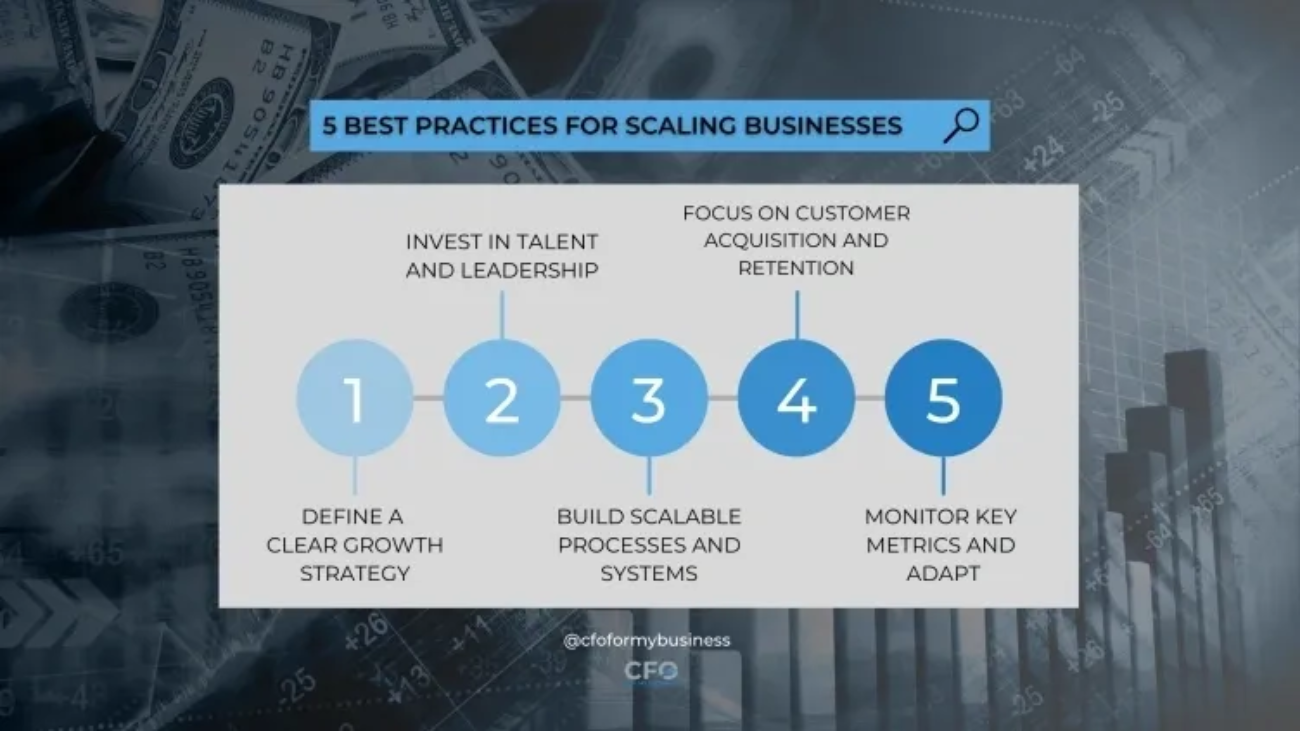
Unlocking Business Growth: 5 Best Practices for Scaling Success

As a fractional CFO, I have had the privilege of working with numerous business owners and CEOs on scaling their businesses for long-term growth and success. Scaling a business requires careful planning, strategic decision-making, and a focus on key practices that drive sustainable expansion. In this article, I will share five best practices that I have found to be instrumental in scaling businesses effectively.


**1. Define a Clear Growth Strategy**

Scaling a business without a well-defined growth strategy is like setting sail without a destination in mind. It is crucial to establish a clear vision of where you want your business to go and create a roadmap to get there. Consider the following steps:

– Conduct a comprehensive analysis of your industry, market trends, and competitive landscape.

– Identify new growth opportunities, target markets, and customer segments.

– Set specific, measurable, achievable, relevant, and time-bound (SMART) goals to guide your scaling efforts.

– Develop a detailed plan outlining the necessary actions, resources, and milestones to achieve your growth objectives.


**2. Invest in Talent and Leadership**

A successful scale-up requires a capable and motivated team. Invest in hiring and retaining top talent to fuel your growth. Consider these practices:

– Define clear job descriptions and competency requirements for each role.

– Recruit individuals who align with your company culture and values.

– Provide ongoing training and development opportunities to enhance skills and knowledge.

– Establish effective leadership practices to empower and inspire your team.

– Foster a collaborative and inclusive work environment that encourages innovation and creativity.


**3. Build Scalable Processes and Systems**

As your business grows, the processes and systems you have in place must be able to scale with it. Streamline operations and ensure efficiency by:

– Documenting and standardizing key processes to create consistency.

– Implementing technology solutions that automate and optimize workflows.

– Regularly reviewing and refining your processes to eliminate bottlenecks and inefficiencies.

– Developing a scalable infrastructure that can support increased demand and future growth.


**4. Focus on Customer Acquisition and Retention**

Scaling a business is not just about acquiring new customers; it also involves retaining existing ones. Prioritize customer acquisition and retention strategies by:

– Identifying your ideal customer profile and targeting your marketing efforts accordingly.

– Implementing a robust lead generation and nurturing process.

– Providing exceptional customer experiences to build loyalty and advocacy.

– Actively seeking customer feedback and using it to improve your products or services.

– Developing customer retention initiatives such as loyalty programs or personalized offers.


**5. Monitor Key Metrics and Adapt**

To successfully scale your business, you need to monitor key performance indicators (KPIs) and adapt your strategies accordingly. Consider the following practices:

– Identify and track relevant KPIs that align with your growth objectives.

– Establish a regular reporting and review process to monitor progress.

– Analyze data and metrics to gain insights into areas of improvement or potential risks.

– Stay agile and be willing to adjust your strategies based on market changes or emerging trends.

– Foster a culture of continuous improvement and learning within your organization.


In conclusion, scaling your business requires strategic planning, diligent execution, and a commitment to continuous improvement. By implementing the five best practices outlined in this article – with the guidance and expertise of a fractional CFO – you can position your business for long-term success.

A fractional CFO can provide invaluable insights and financial expertise to support your scaling efforts. Their strategic guidance can help you develop a clear growth strategy, optimize your financial processes, and make data-driven decisions. Consider partnering with a fractional CFO to maximize the effectiveness of these best practices and accelerate your scaling journey.

Remember, scaling is a journey, and success is not achieved overnight. Embrace these practices with the assistance of a fractional CFO as your trusted advisor. By consistently applying these best practices and leveraging the expertise of a CFO, you can set yourself on the path to sustainable growth and expansion.


🚀Ready to scale your business for long-term success?📊

As a fractional CFO, I’m here to guide you through the process and help you achieve your growth objectives. Let’s work together to define a clear growth strategy, invest in top talent, build scalable processes, prioritize customer acquisition and retention, and monitor key metrics for continuous improvement.

Reach out today for a FREE 30-minute strategy call and start your journey towards scaling your business effectively. Your success awaits!

📞(602) 832-7070

Ron Elwood, CFO For My Business

Let’s take your business to new heights!🔝

#ScaleYourBusiness #FractionalCFO #BusinessGrowth #SustainableSuccess#cfoformybusiness

Wishing you all the best on your scaling journey!


If you found this article helpful, share your thoughts and experiences in the comments below, and feel free to reach out if you have any questions or need further guidance.