
Cash Flow Management Mistakes Small Business Owners Make (And How to Fix Them)

Cash Flow Management Mistakes Small Business Owners Make (And How to Fix Them)

10 Cash Flow Management Mistakes Small Business Owners Make (And How to Fix Them) | CFO for My Business

10 Cash Flow Management Mistakes Small Business Owners Make (And How to Fix Them)

Expert Insights from CFO for My Business | Protect Your Business from Common Financial Pitfalls

Cash flow problems are the leading cause of small business failure. According to recent studies, 82% of small businesses that fail do so because of cash flow mismanagement. The good news? Most cash flow mistakes are entirely preventable when you know what to look for and how to fix them.

Why Cash Flow Mistakes Are Deadly for Small Businesses

Cash flow is the lifeblood of any business. Even highly profitable companies can find themselves in serious trouble if they cannot access cash when needed to pay employees, vendors, rent, and other essential expenses. Unlike large corporations with extensive credit lines and cash reserves, small businesses operate with much tighter margins for error, making cash flow management mistakes particularly dangerous.

The challenge lies in the fact that many small business owners are excellent at their craft—whether that's providing professional services, creating products, or delivering customer experiences—but lack formal financial training. This knowledge gap leads to predictable patterns of cash flow mistakes that, while common, can have devastating consequences for business survival and growth.

Understanding these mistakes and implementing proven solutions is not just about avoiding failure; it's about creating a foundation for sustainable growth, reducing financial stress, and building a business that can weather economic uncertainties. The ten mistakes outlined in this comprehensive guide represent the most common and impactful cash flow errors observed across thousands of small businesses. More importantly, we provide actionable solutions you can implement immediately to protect and strengthen your business's financial health.

82%
of small businesses fail due to cash flow problems
60%
of small business owners feel they lack financial knowledge
69%
of business owners lose sleep over cash flow concerns

Struggling With Cash Flow Management?

Get expert CFO guidance to identify and fix the cash flow issues holding your business back

Top Cash Flow Challenges Facing Small Businesses (%)
88%
Late Customer Payments
75%
Unexpected Expenses
68%
Seasonal Fluctuations
62%
Growth Demands
1
Not Separating Personal and Business Finances

One of the most fundamental yet frequently made mistakes is commingling personal and business finances. When business owners use personal accounts for business expenses or vice versa, it creates a chaotic financial situation that makes accurate cash flow tracking virtually impossible. This mixing obscures the true financial health of your business, complicates tax preparation, increases audit risk, and can even pierce the corporate veil, exposing personal assets to business liabilities.

The problem often starts innocuously—using a personal credit card for a business purchase "just this once" or transferring money between accounts without proper documentation. Over time, these small infractions become habitual, creating a tangled web of transactions that even professional accountants struggle to unravel. The resulting lack of clarity makes it impossible to understand whether your business is genuinely profitable or if you're subsidizing it with personal funds.

The Solution: Create Clear Financial Boundaries

  • Open dedicated business checking and savings accounts immediately
  • Obtain a business credit card for all business-related purchases
  • Establish a regular owner's draw or salary rather than taking money ad-hoc
  • Document any loans between personal and business accounts with proper paperwork
  • Use accounting software that clearly tracks business vs. personal transactions
  • Reconcile accounts monthly to catch any mixing before it becomes problematic
Critical Warning: Mixing personal and business finances can void your LLC or corporation protection, making personal assets vulnerable to business lawsuits and liabilities. The legal consequences alone justify maintaining strict separation.
2
Failing to Create Cash Flow Forecasts

Flying blind is never a good business strategy, yet countless small business owners operate without any forward-looking view of their cash position. Without cash flow forecasts, you're essentially driving your business while looking only in the rearview mirror. By the time you realize there's a problem, it may be too late to avoid a cash crunch. Cash flow forecasting allows you to anticipate shortfalls weeks or months in advance, giving you time to secure financing, adjust expenses, or accelerate collections.

Many business owners avoid forecasting because they find it intimidating or time-consuming. Others mistakenly believe their business is too unpredictable to forecast accurately. In reality, even rough forecasts based on historical patterns and known upcoming events provide exponentially more value than no forecast at all. The goal isn't perfect prediction but rather directional awareness that enables proactive decision-making.

The Solution: Implement Rolling Cash Flow Forecasts

  • Start with a simple 13-week rolling forecast updated weekly
  • Track actual vs. forecasted results to improve accuracy over time
  • Include all expected cash inflows (collections, investments) and outflows (payroll, rent, vendors)
  • Account for timing differences between sales and cash collection
  • Create best-case, worst-case, and most-likely scenarios
  • Review forecasts with your team to identify risks and opportunities early
  • Use forecasting software or templates to simplify the process
Learn more about cash flow optimization strategies and best practices
3
Extending Credit Without Proper Terms

The eagerness to win customers often leads small business owners to extend credit too freely without establishing clear payment terms, conducting credit checks, or implementing collection procedures. This mistake transforms sales into liabilities, as revenue on paper doesn't pay your bills—only collected cash does. When customers pay 60, 90, or even 120+ days after delivery, you're essentially providing them with interest-free financing while struggling to cover your own expenses.

The problem compounds when businesses lack formal credit policies. Without clear expectations communicated upfront, customers may assume extended payment terms are acceptable, making collection efforts awkward and potentially damaging to relationships. Meanwhile, your business bears the cost of providing goods or services without compensation for potentially months.

Business Type Recommended Payment Terms Deposit Requirement Risk Level
Retail Payment at time of sale N/A Low
Professional Services Net 15-30 days 25-50% upfront Medium
Manufacturing Net 30 days 30-50% upfront Medium
Custom/Project Work Progress billing milestones 33-50% upfront High
SaaS/Subscriptions Payment in advance N/A - prepaid Low

The Solution: Establish and Enforce Credit Policies

  • Create written credit policies specifying payment terms, late fees, and collection procedures
  • Require deposits for new customers or large orders (typically 25-50%)
  • Implement credit checks for customers requesting payment terms
  • Clearly communicate payment expectations before work begins
  • Include payment terms prominently on all invoices and contracts
  • Offer early payment discounts (e.g., 2% discount for payment within 10 days)
  • Accept multiple payment methods to reduce friction
  • Consider progress billing for long-term projects
4
Poor Inventory Management

For product-based businesses, inventory represents one of the largest cash investments and a common source of cash flow problems. Holding too much inventory ties up cash in products sitting on shelves rather than being available for operational needs or growth investments. Conversely, insufficient inventory leads to stockouts, lost sales, and disappointed customers. The challenge is finding the optimal balance that minimizes cash tied up in inventory while ensuring adequate availability to meet customer demand.

Poor inventory management often stems from inadequate tracking systems, inaccurate demand forecasting, or emotional decision-making (buying too much because of a good deal or fear of stockouts). Many small businesses also fail to regularly review inventory for slow-moving or obsolete items, allowing dead stock to accumulate and consume valuable cash and storage space.

The Solution: Optimize Inventory Levels

  • Implement inventory management software to track stock levels in real-time
  • Calculate optimal reorder points based on lead times and sales velocity
  • Conduct regular physical inventory counts to identify discrepancies
  • Analyze inventory turnover ratios and focus on improving slow-moving items
  • Negotiate favorable terms with suppliers including consignment or drop-shipping where possible
  • Use just-in-time inventory principles for predictable, fast-moving items
  • Run promotions to clear out slow-moving or seasonal inventory
  • Establish relationships with multiple suppliers to reduce risk and improve flexibility
5
Paying Bills Too Early or Too Late

The timing of bill payment is a delicate balancing act that many small business owners get wrong in both directions. Paying bills too early—immediately upon receipt rather than at the due date—unnecessarily depletes cash reserves and forfeits the benefit of interest-free credit your suppliers are extending. On the other hand, consistently paying late damages vendor relationships, may incur late fees and interest charges, can harm your business credit score, and risks interruption of critical services or supplies.

This mistake often occurs because business owners either lack systems for tracking payment due dates or don't understand the strategic importance of payment timing in cash flow management. Every dollar paid 30 days early is a dollar unavailable for other uses during that period. Conversely, every payment made late costs you in relationship capital and potentially in hard dollars through fees and penalties.

The Solution: Strategic Payment Timing

  • Create a payment calendar tracking all due dates and payment terms
  • Schedule payments to arrive on (not before) the due date
  • Negotiate extended payment terms with vendors when possible
  • Take advantage of early payment discounts only when financially beneficial (generally 2% or more)
  • Use business credit cards for purchases to extend payment periods by 30-45 days
  • Prioritize payments based on criticality and relationship value
  • Communicate proactively with vendors if you anticipate payment delays
  • Automate recurring payments to ensure consistency and avoid late fees
Important Consideration: While strategic payment timing is good practice, never sacrifice important vendor relationships for minor cash flow benefits. Your reputation for reliability is worth more than a few extra days of float.

Ready to Fix Your Cash Flow Issues?

Our experienced CFO team can help you implement proven systems to optimize your cash flow and strengthen your business finances

6
Ignoring Seasonal Cash Flow Patterns

Many businesses experience predictable seasonal fluctuations in revenue and cash flow, yet fail to plan accordingly. Retailers may see 40-50% of annual revenue in the fourth quarter, landscaping businesses operate primarily in spring and summer, and tax professionals work intensively during tax season. Despite these predictable patterns, many business owners are caught off guard each year by seasonal cash shortages during slow periods or struggle to manage excess cash during peak seasons.

The failure to plan for seasonality creates a boom-and-bust cycle where businesses struggle to cover fixed expenses during slow periods and scramble to fulfill demand during peak times. This reactive approach often results in expensive last-minute financing, missed opportunities, and chronic financial stress.

The Solution: Plan for Seasonal Variations

  • Analyze historical data to identify seasonal revenue patterns
  • Build cash reserves during peak seasons to cover slow periods
  • Adjust staffing levels to match seasonal demand using temporary or part-time workers
  • Negotiate flexible payment terms with suppliers that align with your seasonal cash flow
  • Diversify revenue streams to smooth seasonal fluctuations
  • Secure a line of credit before you need it to bridge seasonal gaps
  • Create separate savings accounts for taxes and known upcoming expenses
  • Develop off-season services or products to generate year-round income
7
Growing Too Fast Without Cash Reserves

Rapid growth is exciting, but it's also one of the most dangerous periods for business cash flow. Every new customer, employee, or location requires upfront investment in inventory, equipment, marketing, and working capital before generating returns. Without adequate cash reserves to fund this growth, businesses find themselves in a paradoxical situation: failing because they're succeeding too well. This phenomenon, often called "growing broke," has destroyed countless promising businesses.

The problem intensifies when businesses take on large contracts or major clients that require significant upfront investment or have extended payment terms. A $500,000 contract sounds wonderful until you realize it requires $200,000 in materials and labor upfront, with payment potentially months away. Without proper planning and reserves, accepting such opportunities can actually push a business toward insolvency.

Growth Scenario Cash Reserve Needed Timing Challenge Risk Level
Hiring New Employees 3-6 months salary Pay before productivity Medium
Opening New Location 6-12 months operating costs Buildout before revenue High
Large Customer Contract 50-100% of contract value Deliver before collection High
New Product Launch 100-200% of development cost Investment before sales High

The Solution: Strategic Growth Management

  • Build cash reserves equal to 3-6 months of operating expenses before aggressive expansion
  • Calculate the working capital requirements of growth opportunities before committing
  • Grow in measured steps rather than quantum leaps
  • Secure growth financing (line of credit, term loans) before you need it
  • Negotiate deposits and progress payments for large projects
  • Focus on profitability and cash generation, not just revenue growth
  • Monitor cash flow weekly during growth phases
  • Have contingency plans if growth doesn't materialize as expected
8
Not Following Up on Overdue Invoices

Many business owners are uncomfortable with collections, viewing it as confrontational or worrying that aggressive follow-up will damage customer relationships. This discomfort leads to passive collection approaches—sending invoices and hoping customers pay on time without proactive follow-up. The result is predictable: payment times stretch from 30 to 60 to 90+ days, creating artificial cash shortages even though revenue appears strong on paper.

The longer an invoice remains unpaid, the less likely it will be collected. Industry data shows that invoices 90 days past due have only a 70% collection rate, dropping to 50% at six months and just 25% after one year. Every day that passes without collection action reduces the probability of payment while the cash flow damage to your business increases.

The Solution: Systematic Collections Process

  • Send invoices immediately upon delivery of goods or services
  • Follow up with a friendly reminder 3-5 days before the due date
  • Make a phone call on the day payment becomes overdue
  • Send formal past-due notices at 15, 30, and 45 days
  • Escalate to a collections agency or attorney after 60-90 days
  • Document all collection attempts and communications
  • Be professional but firm—you've earned this money
  • Consider requiring upfront payment for customers with payment history issues
  • Use automated invoicing and reminder systems to reduce manual work
Reality Check: Asking for money you're legitimately owed is not confrontational—it's professional. Customers who react negatively to reasonable collection efforts are often the ones you're better off not having. Good customers appreciate clear processes and respect boundaries.
9
Underpricing Products or Services

The fear of losing customers to competitors often drives small business owners to underprice their offerings, sometimes severely. While competitive pricing is important, charging too little creates multiple cash flow problems: insufficient profit margins to cover unexpected expenses, inability to build cash reserves, and the necessity of high sales volumes just to break even. Businesses operating on thin margins have virtually no margin for error—any expense increase, sales decline, or operational hiccup can trigger a cash crisis.

Underpricing is particularly insidious because businesses can appear busy and successful while slowly bleeding cash. When every sale barely covers costs, even high sales volumes generate insufficient cash to fund operations, growth, or emergencies. The solution isn't always raising prices across the board, but rather understanding your true costs, your value proposition, and pricing accordingly.

The Solution: Value-Based Pricing Strategy

  • Calculate your true fully-loaded costs including overhead, labor, materials, and a profit margin
  • Research competitor pricing but don't automatically underprice them
  • Focus on differentiating value rather than competing solely on price
  • Consider raising prices 5-10% for new customers to test sensitivity
  • Create premium tiers or add-on services for additional revenue
  • Implement regular price reviews (annually minimum) to ensure alignment with costs
  • Communicate value clearly to justify pricing
  • Calculate the impact of price changes on cash flow and profitability
  • Be willing to walk away from customers who only choose based on lowest price
10
Lacking Emergency Cash Reserves

Operating without adequate cash reserves is like driving without insurance—everything seems fine until something goes wrong, and then it's catastrophic. Emergency reserves provide a critical buffer against unexpected expenses, revenue shortfalls, economic downturns, or major opportunities that require quick action. Without reserves, businesses face impossible choices when challenges arise: take on expensive emergency financing, cut essential services, lay off valued employees, or potentially close operations.

Many business owners justify the absence of reserves by claiming they're reinvesting everything into growth or that revenues are too inconsistent to build reserves. These rationalizations ignore the reality that emergencies are inevitable, not hypothetical. Equipment breaks, customers default, economic conditions change, and opportunities arise. Businesses with reserves navigate these situations; businesses without them struggle or fail.

The Solution: Build and Maintain Cash Reserves

  • Target 3-6 months of operating expenses in liquid reserves
  • Start small if necessary—even $1,000 is better than zero
  • Set up automatic transfers to a dedicated reserve account each month
  • Treat reserve building as a non-negotiable expense, like rent or payroll
  • Accelerate reserve building during strong revenue periods
  • Keep reserves in high-yield savings accounts for safety and returns
  • Only use reserves for genuine emergencies, not regular operating expenses
  • Replenish reserves immediately after use
  • Consider separate reserves for taxes, equipment replacement, and growth opportunities
Discover advanced cash flow optimization techniques to strengthen your financial position

Creating a Comprehensive Cash Flow Management System

While understanding individual mistakes is important, the most effective approach is creating a comprehensive cash flow management system that prevents these issues systematically. Such a system doesn't require extensive financial expertise or expensive software—it requires consistency, discipline, and attention to a few key practices.

Essential Components of Effective Cash Flow Management

1. Regular Monitoring and Reporting

  • Review your cash position daily or weekly, not just monthly
  • Maintain a 13-week rolling cash flow forecast
  • Track key metrics like days sales outstanding and cash conversion cycle
  • Compare actual results to forecasts and investigate variances
  • Create dashboard reports that provide at-a-glance visibility

2. Automated Systems and Processes

  • Use cloud-based accounting software for real-time financial visibility
  • Implement automated invoicing and payment reminder systems
  • Set up automatic bill payment for fixed recurring expenses
  • Integrate banking systems with accounting software
  • Use project management tools to track work in progress and billing milestones

3. Professional Guidance and Accountability

  • Work with a fractional CFO or financial advisor for strategic guidance
  • Engage a bookkeeper or accountant for accurate financial records
  • Join peer advisory groups to learn from others' experiences
  • Schedule regular financial reviews with advisors
  • Invest in financial education through courses, books, or workshops
Implementation Tip: Don't try to fix everything at once. Start by addressing the top 2-3 mistakes most relevant to your situation, implement solutions systematically, and then move to the next issues. Sustainable improvement comes from consistent progress, not overwhelming overhauls.

Cash Flow Management Checklist

  • Review cash position at least weekly
  • Update cash flow forecast every Monday morning
  • Send invoices within 24 hours of delivery
  • Follow up on invoices before they become overdue
  • Contact customers on the day payments become late
  • Review accounts receivable aging report weekly
  • Optimize payment timing to preserve cash without damaging relationships
  • Monitor inventory levels and turnover monthly
  • Review and reduce unnecessary expenses quarterly
  • Build cash reserves with every profitable month
  • Maintain 3-6 months operating expenses in reserves
  • Separate personal and business finances completely
  • Review pricing annually to ensure adequate margins
  • Plan for seasonal variations in advance
  • Evaluate growth opportunities through a cash flow lens

Frequently Asked Questions About Cash Flow Management Mistakes

What's the biggest cash flow mistake small businesses make?

While all ten mistakes covered in this article are significant, the single biggest cash flow mistake is failing to forecast and monitor cash flow proactively. Without forward-looking visibility into cash positions, business owners cannot anticipate shortfalls, plan for opportunities, or make informed decisions about spending and growth. This fundamental oversight leads to reactive crisis management rather than proactive cash flow optimization. The good news is that implementing even basic cash flow forecasting—starting with a simple 13-week rolling projection—immediately improves financial awareness and decision-making. Business owners who commit to weekly cash flow reviews typically see dramatic improvements in their financial stability and stress levels within just a few months.

How can I improve cash flow quickly when money is tight?

When facing an immediate cash crunch, focus on the fastest levers to generate cash. First, contact all customers with outstanding invoices over 30 days and request immediate payment—offer a small discount if necessary to accelerate collection. Second, review all upcoming non-essential expenses and delay any that can wait 30-60 days. Third, contact your vendors to negotiate extended payment terms for upcoming bills. Fourth, consider offering early payment discounts to customers (such as 2% off for payment within 10 days) to accelerate future receipts. Fifth, if you have inventory, promote slow-moving items with special sales to convert stock to cash. Finally, review all subscription services and recurring charges, canceling anything not immediately essential. These actions can often free up thousands of dollars within weeks, providing breathing room to implement longer-term solutions.

Should I use my personal savings to fund my business cash flow?

This is a complex question that depends on your specific circumstances, but generally speaking, regularly using personal savings to cover business cash flow shortfalls is a red flag indicating deeper problems that need addressing. If your business cannot generate sufficient cash to cover its operating expenses, the issue isn't lack of capital—it's a fundamental business model problem related to pricing, expenses, collections, or operations. Continuously injecting personal funds masks these problems and delays necessary corrective action. That said, there are appropriate situations for using personal funds: providing initial startup capital, covering one-time unexpected expenses, or bridging a specific temporary shortfall with a clear repayment plan. The key distinction is between strategic, one-time investments versus ongoing subsidization of unprofitable operations. If you find yourself regularly tapping personal savings, it's time to conduct a thorough review of your business model and either fix the fundamental issues or reconsider whether the business is viable.

How much cash should my small business have in reserves?

Financial experts generally recommend small businesses maintain cash reserves equal to 3-6 months of operating expenses. The appropriate level within this range depends on several factors: the predictability of your revenue (more volatile businesses need larger reserves), your access to credit (those with established lines of credit can operate with slightly lower reserves), your industry (capital-intensive businesses need more reserves), and your risk tolerance. To calculate your target, first determine your monthly operating expenses including payroll, rent, utilities, insurance, and other fixed costs—exclude one-time expenses and owner's draw. Then multiply by your target number of months (start with 3 if building reserves is challenging, work toward 6 for optimal security). If this target seems overwhelming, start smaller. Even $5,000-$10,000 in reserves is vastly better than zero and can cover many common emergency situations. Build reserves systematically by allocating a percentage of profits each month until reaching your target.

When should I hire a CFO or financial advisor to help with cash flow?

Consider engaging professional financial help when you experience any of these situations: consistently worrying about making payroll or paying bills, repeatedly being surprised by cash shortages despite profitable operations, growing rapidly and unsure about funding requirements, considering major investments or expansion, experiencing seasonal cash flow challenges you can't navigate, spending excessive time on financial management instead of core business activities, or simply lacking confidence in your financial decision-making. Many small businesses assume they can't afford professional CFO services, but fractional or part-time CFO services have made expert financial guidance accessible at a fraction of full-time CFO costs. The value often far exceeds the cost—a good CFO can typically identify savings and opportunities worth multiples of their fees within months. Start with an initial consultation to assess your situation and get recommendations. The peace of mind alone makes professional guidance worthwhile for many business owners.

Taking Control of Your Business Cash Flow

Cash flow management mistakes are incredibly common among small business owners, but they're also entirely preventable and correctable with the right knowledge, systems, and support. The ten mistakes outlined in this guide represent years of observed patterns across thousands of businesses—patterns that you can now avoid by implementing the solutions provided.

Remember that improving cash flow management is a journey, not a destination. Start by identifying which mistakes currently affect your business most significantly, then systematically implement the corresponding solutions. Even addressing just 2-3 of these issues can dramatically improve your financial stability and peace of mind. As you gain confidence and see results, continue expanding your cash flow management capabilities.

The businesses that thrive long-term aren't necessarily those with the highest revenues or the most customers—they're the ones that master the fundamental discipline of cash flow management. By avoiding these common mistakes and building robust financial management systems, you position your business for sustainable growth, profitability, and success regardless of economic conditions or competitive pressures.

Next Steps: Review the ten mistakes outlined in this article and honestly assess which ones currently impact your business. Prioritize the top 2-3 issues, implement the recommended solutions over the next 30-60 days, and measure the results. Many business owners are surprised by how quickly cash flow improves when they address even a few key issues systematically.

Get Expert Help With Your Cash Flow Management

Don't navigate cash flow challenges alone. Our experienced CFO team at CFO for My Business has helped hundreds of small businesses identify and fix their cash flow issues, creating stable, profitable operations that support their growth goals.

Visit cfoformybusiness.com to learn more about our services and how we can help transform your business's financial health.


What is Cash Flow Optimization and Why Your Business Needs It in 2026

What is Cash Flow Optimization and Why Your Business Needs It in 2026

What is Cash Flow Optimization and Why Your Business Needs It in 2026 | CFO for My Business

What is Cash Flow Optimization and Why Your Business Needs It in 2026

Expert Financial Guidance from CFO for My Business | Updated for 2026

Introduction to Cash Flow Optimization

In the rapidly evolving business landscape of 2026, cash flow optimization has emerged as one of the most critical determinants of business success and sustainability. While many business owners focus primarily on revenue generation and profit margins, the ability to effectively manage and optimize cash flow can mean the difference between thriving and merely surviving in today's competitive marketplace.

Cash flow optimization goes beyond simple bookkeeping or maintaining a positive bank balance. It represents a comprehensive strategic approach to managing the timing, magnitude, and predictability of cash movements within your organization. As we navigate through 2026, businesses face unprecedented challenges including economic volatility, supply chain disruptions, changing customer payment behaviors, and increasing operational costs. In this environment, optimizing cash flow is not just a financial best practice but a fundamental requirement for business resilience and growth.

This comprehensive guide will explore everything you need to know about cash flow optimization, from its fundamental principles to advanced strategies tailored for the current business environment. Whether you're a startup founder, small business owner, or executive at an established company, understanding and implementing cash flow optimization strategies can significantly enhance your organization's financial health, operational efficiency, and long-term viability.

Ready to Optimize Your Business Cash Flow?

Get expert CFO guidance tailored to your business needs

What is Cash Flow Optimization?

Cash flow optimization is the strategic process of maximizing the efficiency with which cash moves through your business operations. It involves carefully analyzing, forecasting, and managing both cash inflows (receivables, sales revenue, investments) and cash outflows (payables, operational expenses, capital expenditures) to ensure your business maintains adequate liquidity while maximizing returns on available capital.

At its core, cash flow optimization seeks to answer three fundamental questions: How much cash does your business have right now? How much cash will your business need in the future? How can you ensure the right amount of cash is available at the right time? By addressing these questions proactively, businesses can avoid cash crunches, reduce reliance on expensive short-term financing, and create opportunities for strategic investments and growth initiatives.

82%
of small businesses fail due to cash flow problems
60%
of businesses struggle with late customer payments
30-45
days average to receive payment in 2026

The Cash Flow Cycle Explained

Understanding the cash flow cycle is fundamental to optimization. The cycle typically includes four key phases: cash is invested in inventory or materials, products or services are created, sales are generated (often on credit), and finally, cash is collected from customers. The time it takes to complete this cycle directly impacts your working capital requirements and overall financial flexibility.

Average Cash Conversion Cycle by Industry (Days)
67
Retail
82
Manufacturing
48
Technology
58
Professional Services

Why Cash Flow Optimization Matters in 2026

The business environment of 2026 presents unique challenges that make cash flow optimization more critical than ever before. Global economic uncertainty, rapid technological changes, evolving consumer behaviors, and increased competition have created a landscape where financial agility can be your greatest competitive advantage.

Economic and Market Factors

In 2026, businesses are navigating persistent inflation pressures, fluctuating interest rates, and supply chain complexities that directly impact cash flow dynamics. The cost of borrowing remains elevated compared to historical norms, making inefficient cash management significantly more expensive. Companies that optimize their cash flow can reduce reliance on external financing, negotiate better terms with suppliers and lenders, and maintain greater control over their financial destiny.

Operational Excellence and Growth

Cash flow optimization enables businesses to operate more efficiently and pursue growth opportunities without being constrained by working capital limitations. When cash is managed effectively, organizations can invest in innovation, expand into new markets, upgrade technology infrastructure, and attract top talent—all while maintaining financial stability. This operational flexibility is particularly valuable in fast-moving industries where the ability to act quickly on opportunities can determine market leadership.

Key Insight: Businesses with optimized cash flow are 3.5 times more likely to survive economic downturns and 2.8 times more likely to achieve sustainable growth compared to those with poor cash flow management practices.

Transform Your Business Financial Health

Let our experienced CFO team help you implement proven cash flow optimization strategies

Key Components of Cash Flow Optimization

Effective cash flow optimization requires attention to multiple interconnected components that collectively determine your organization's financial performance and liquidity position. Understanding these components and how they interact is essential for developing a comprehensive optimization strategy.

Accounts Receivable Management

Accelerating cash collection from customers is often the most impactful lever for improving cash flow. This involves establishing clear payment terms, implementing efficient invoicing processes, offering early payment incentives, and maintaining disciplined collection procedures. In 2026, leveraging digital payment platforms and automated reminders can significantly reduce days sales outstanding while improving customer relationships.

Accounts Payable Optimization

Strategic management of payables allows businesses to preserve cash without damaging supplier relationships. This includes negotiating favorable payment terms, taking advantage of early payment discounts when financially beneficial, and timing payments to optimize cash availability. Smart payable management means paying obligations when due rather than prematurely, thereby maximizing the use of interest-free supplier credit.

Inventory Management

For businesses carrying inventory, this represents a significant cash investment that must be optimized. Implementing just-in-time inventory practices, improving demand forecasting accuracy, reducing obsolete stock, and negotiating consignment arrangements with suppliers can free up substantial capital while maintaining operational effectiveness.

Cash Flow Component Optimization Goal Target Improvement Impact Level
Days Sales Outstanding Reduce collection time 15-30% reduction High
Days Payable Outstanding Optimize payment timing 10-20% extension High
Inventory Turnover Increase efficiency 20-40% improvement Medium-High
Operating Expenses Reduce waste 5-15% reduction Medium
Cash Forecasting Accuracy Improve predictions 90%+ accuracy High

Working Capital Efficiency

Working capital—the difference between current assets and current liabilities—represents the operating liquidity available to your business. Optimizing working capital involves balancing the need for operational flexibility with the efficient use of financial resources. This includes maintaining appropriate cash reserves, managing short-term investments, and ensuring access to credit facilities for unexpected needs or opportunities.

Proven Strategies for Optimizing Cash Flow

Implementing effective cash flow optimization requires a combination of tactical improvements and strategic initiatives. The following strategies have proven particularly effective for businesses operating in the 2026 economic environment.

Revenue and Collections Enhancement

  • Implement automated invoicing systems that generate and send invoices immediately upon delivery of goods or services, reducing delays in the billing cycle
  • Offer multiple payment options including digital wallets, ACH transfers, and credit cards to reduce friction in the payment process
  • Create early payment incentives such as 2% discount for payment within 10 days, which can significantly accelerate cash collection
  • Establish clear credit policies that include upfront deposits for large orders, progress billing for long-term projects, and credit limits based on customer payment history
  • Implement subscription or retainer models where appropriate to create predictable recurring revenue streams

Expense and Payment Management

  • Conduct regular expense audits to identify and eliminate unnecessary costs, renegotiate contracts, and consolidate vendors for better pricing
  • Implement zero-based budgeting for discretionary expenses, requiring justification for each expenditure rather than simply continuing historical spending patterns
  • Negotiate extended payment terms with suppliers, particularly for large or regular purchases, to preserve cash longer
  • Use business credit cards strategically for purchases to extend payment periods by 30-45 days while earning rewards
  • Implement approval workflows for significant expenditures to ensure all spending aligns with strategic priorities and cash availability

Forecasting and Planning

Accurate cash flow forecasting is the foundation of effective optimization. In 2026, sophisticated forecasting tools leverage artificial intelligence and machine learning to predict cash movements with unprecedented accuracy. Businesses should develop rolling 13-week cash flow forecasts that are updated weekly, along with longer-term quarterly and annual projections. These forecasts should incorporate multiple scenarios including best case, worst case, and most likely outcomes to support contingency planning.

Impact of Cash Flow Optimization Strategies (% Improvement)
42%
Faster Collections
28%
Extended Payables
35%
Inventory Reduction
22%
Expense Control

How to Implement Cash Flow Optimization

Successfully implementing cash flow optimization requires a systematic approach that engages your entire organization and establishes sustainable processes and accountability structures. The following implementation framework has proven effective across businesses of various sizes and industries.

  1. Assess Your Current State: Begin with a comprehensive analysis of your current cash flow situation. Review historical cash flow statements, analyze your cash conversion cycle, identify bottlenecks in collections and payments, and benchmark your performance against industry standards. This baseline assessment provides the foundation for improvement initiatives.
  2. Set Clear Objectives: Establish specific, measurable goals for your cash flow optimization efforts. These might include reducing days sales outstanding by 20%, improving inventory turnover by 30%, or increasing operating cash flow by $500,000 annually. Clear objectives provide direction and enable progress measurement.
  3. Develop an Action Plan: Create a detailed roadmap outlining specific initiatives, responsible parties, timelines, and required resources. Prioritize actions based on potential impact and implementation difficulty, focusing first on high-impact, low-difficulty improvements that can generate quick wins and build momentum.
  4. Implement Technology Solutions: Invest in appropriate technology infrastructure including accounting software, cash flow forecasting tools, automated invoicing systems, and payment platforms. Modern cloud-based solutions offer powerful capabilities at reasonable costs, making sophisticated cash flow management accessible to businesses of all sizes.
  5. Train Your Team: Ensure all relevant team members understand cash flow principles, their role in optimization efforts, and how to use new tools and processes effectively. This includes finance staff, salespeople who affect collections, purchasing personnel who manage payables, and operational managers who control inventory and expenses.
  6. Monitor and Adjust: Establish regular review processes to track key metrics, assess progress toward objectives, and identify new opportunities or challenges. Monthly management reviews should include cash flow analysis as a standard agenda item, with quarterly deep dives into optimization strategies and results.
Implementation Tip: Start with a 90-day pilot program focusing on one or two high-impact areas. This allows you to test approaches, refine processes, and demonstrate value before rolling out broader initiatives across your organization.

Common Challenges and Solutions

While the benefits of cash flow optimization are substantial, businesses often encounter obstacles during implementation. Understanding these challenges and having strategies to address them can significantly improve your success rate.

Challenge Impact Solution
Inconsistent customer payments Unpredictable cash inflows make planning difficult Implement automated payment reminders, require deposits, offer payment plans, and establish clear consequences for late payments
Seasonal revenue fluctuations Cash shortages during slow periods despite annual profitability Build cash reserves during peak seasons, secure line of credit for off-peak periods, diversify revenue streams to smooth fluctuations
Rapid growth demands Increased working capital needs strain available cash Implement milestone-based customer payments, negotiate favorable vendor terms, consider growth financing options like invoice factoring or asset-based lending
Limited financial visibility Inability to anticipate and plan for cash needs Invest in financial management systems, implement rolling cash flow forecasts, establish regular reporting cadence
Resistance to change Difficulty implementing new processes and behaviors Communicate benefits clearly, involve team in planning, celebrate wins, provide training and support, link performance metrics to optimization goals

Managing Growth Without Cash Flow Strain

One of the most common challenges facing successful businesses is managing the cash flow implications of growth. Rapid expansion often requires increased inventory, larger receivables balances, and higher operating expenses before additional revenue is realized. To manage growth effectively, implement scalable systems early, maintain rigorous financial discipline, and consider financing options that align with your growth trajectory such as revenue-based financing or strategic partnerships that provide capital along with market access.

Technology and Tools for Cash Flow Optimization in 2026

The technology landscape of 2026 offers unprecedented capabilities for cash flow management and optimization. Modern solutions leverage artificial intelligence, machine learning, and real-time data integration to provide insights and automation that were previously unavailable to most businesses.

Essential Technology Categories

  • Cloud-based accounting platforms provide real-time financial visibility, automated reconciliation, and integration with banking systems for up-to-the-minute cash position information
  • AI-powered forecasting tools analyze historical patterns, seasonal trends, and external factors to predict future cash flows with 90%+ accuracy
  • Automated invoicing and payment systems reduce manual work, eliminate errors, and accelerate cash collection through electronic delivery and payment options
  • Cash flow dashboards provide visual, intuitive access to key metrics and trends, enabling faster and better decision-making
  • Integrated payment platforms streamline collections by offering customers multiple convenient payment methods while automatically updating accounting records

Emerging Technologies

Looking ahead, emerging technologies are creating new opportunities for cash flow optimization. Blockchain-based payment systems promise near-instantaneous settlement at lower costs. Predictive analytics powered by big data can identify early warning signs of customer payment issues. Open banking APIs enable seamless integration between financial institutions and business systems, providing unprecedented visibility and control over cash movements.

Need Expert Help With Cash Flow Management?

Our CFO team brings decades of experience helping businesses optimize their cash flow and financial performance

Measuring Success: Key Performance Indicators

Effective cash flow optimization requires tracking the right metrics to assess performance, identify trends, and guide decision-making. The following key performance indicators provide comprehensive insight into your cash flow health and optimization progress.

Primary Cash Flow Metrics

Metric What It Measures Target Range Calculation
Operating Cash Flow Ratio Ability to cover current liabilities >1.0 Operating Cash Flow ÷ Current Liabilities
Cash Conversion Cycle Days to convert inventory investment to cash <60 days DSO + DIO - DPO
Days Sales Outstanding Average collection period <45 days (Accounts Receivable ÷ Revenue) × 365
Cash Flow Margin Cash efficiency of operations >10% (Operating Cash Flow ÷ Revenue) × 100
Free Cash Flow Cash available after capital expenditures Positive and growing Operating Cash Flow - Capital Expenditures

Dashboard Reporting

Create a comprehensive cash flow dashboard that provides at-a-glance visibility into these metrics along with cash position, upcoming obligations, and forecast variance analysis. Update this dashboard weekly and review it with key stakeholders regularly to ensure everyone understands the current situation and can act quickly when needed.

Frequently Asked Questions About Cash Flow Optimization

What is the difference between cash flow and profit?

This is one of the most common sources of confusion for business owners. Profit is an accounting concept that represents revenue minus expenses over a period, calculated according to accrual accounting principles. Cash flow, however, represents the actual movement of money into and out of your business. A company can be profitable on paper while experiencing negative cash flow if revenue is recognized before cash is collected or if significant capital investments are required. Conversely, a business might show positive cash flow while being unprofitable if it's collecting advance payments or liquidating assets. Successful businesses need both profitability and positive cash flow, but cash flow is ultimately what keeps operations running and enables growth.

How much cash should my business keep in reserves?

The appropriate cash reserve level depends on several factors including your industry, business model, revenue predictability, and risk tolerance. As a general guideline, most businesses should maintain cash reserves sufficient to cover three to six months of operating expenses. Service businesses with recurring revenue and low capital requirements might operate comfortably with three months of reserves, while manufacturing or retail businesses with higher working capital needs and more volatile revenues should target six months or more. Businesses in growth phases or experiencing seasonal fluctuations may need even larger reserves. Regular cash flow forecasting helps determine the right reserve level for your specific situation and ensures you're prepared for both opportunities and challenges.

Can a profitable business run out of cash?

Absolutely yes, and this is one of the leading causes of business failure. This phenomenon, often called "growing broke," occurs when a profitable business expands faster than its cash flow can support. As sales increase, the business must invest in additional inventory, hire more staff, and extend credit to customers before receiving payment. Even though these sales are profitable on the income statement, the timing gap between cash outflows and inflows can create severe liquidity problems. This is particularly common in businesses with long collection cycles, significant inventory requirements, or those pursuing rapid growth. The solution is rigorous cash flow management, appropriate working capital financing, and growth strategies that balance expansion ambitions with cash flow realities.

What are the warning signs of cash flow problems?

Several red flags indicate potential cash flow problems that require immediate attention. These include consistently paying bills late or negotiating payment extensions with vendors, increasing reliance on credit cards or lines of credit to meet operating expenses, difficulty making payroll on time, declining cash balances despite profitable operations, growing accounts receivable aging with more customers paying late, inability to take advantage of early payment discounts or strategic opportunities due to cash constraints, and frequent "juggling" of which bills to pay when. If you notice any of these warning signs, conduct an immediate cash flow analysis, develop a 13-week rolling forecast, and consider engaging a financial professional to help identify and implement solutions before the situation becomes critical.

How can I improve my business cash flow quickly?

While sustainable cash flow optimization is a long-term process, several strategies can generate quick improvements when you need immediate relief. First, accelerate collections by contacting customers with outstanding invoices, offering small discounts for immediate payment, and implementing stricter credit policies for future sales. Second, delay non-essential expenses and negotiate extended payment terms with vendors. Third, reduce inventory levels by promoting slow-moving items, even at discounted prices, to convert inventory to cash. Fourth, consider invoice factoring or a line of credit to bridge short-term gaps. Fifth, review all subscriptions and recurring expenses to eliminate anything not essential to current operations. These tactical moves can improve your cash position in days or weeks, buying time to implement more comprehensive optimization strategies. However, for lasting improvement, focus on the fundamental drivers: faster collections, strategic payment timing, efficient inventory management, and accurate forecasting.

Conclusion: Taking Action on Cash Flow Optimization

As we've explored throughout this comprehensive guide, cash flow optimization is not merely a financial exercise but a fundamental business strategy that impacts every aspect of your organization's performance and sustainability. In the dynamic business environment of 2026, with its unique challenges and opportunities, the ability to effectively manage and optimize cash flow has become a critical competitive differentiator.

The good news is that cash flow optimization is achievable for businesses of all sizes and industries. While the specific strategies and tools may vary based on your circumstances, the fundamental principles remain constant: understand your cash flow dynamics, implement systems and processes to improve efficiency, leverage technology to gain visibility and control, and maintain disciplined execution of your optimization initiatives.

Success in cash flow optimization requires commitment, but the rewards are substantial. Businesses that master cash flow management enjoy greater financial stability, enhanced strategic flexibility, reduced financing costs, and improved ability to invest in growth and innovation. They're better positioned to weather economic uncertainties, capitalize on opportunities, and build sustainable value over time.

Remember: Cash flow optimization is an ongoing journey, not a one-time project. The most successful businesses treat it as a core competency, continuously refining their approaches, adapting to changing conditions, and staying focused on the metrics that matter most. Whether you're just beginning your optimization journey or looking to take your existing efforts to the next level, the key is to start now and maintain consistent progress toward your goals.

If you're ready to transform your business's cash flow performance but aren't sure where to start, or if you want to accelerate your results with expert guidance, professional CFO services can provide invaluable support. Experienced financial professionals bring proven frameworks, industry best practices, and objective insights that can help you navigate challenges, avoid common pitfalls, and achieve your optimization objectives faster than going it alone.

Partner With Experienced CFO Professionals

Let CFO for My Business help you unlock the full potential of your cash flow and build a stronger, more resilient organization. Our team brings decades of experience helping businesses like yours optimize financial performance and achieve their growth objectives.

Visit us at cfoformybusiness.com to learn more about our services and how we can help your business thrive in 2026 and beyond.

rs=w_1280 (1)

The Rise of Fractional CFOs: Why Your Business Needs One

In the dynamic realm of modern business, the pursuit of innovation and efficiency while minimizing expenditure is a constant endeavor. An emerging and transformative trend is the adoption of Fractional Chief Financial Officers (CFOs) by enterprises, replacing the conventional full-time CFO approach. This transformation is underpinned by a host of compelling factors, substantiated by research, empirical data, and real-world achievements. In the following sections, we delve into the advantages of incorporating a Fractional CFO and elucidate its pivotal role in contemporary business strategies.

Cost-Effectiveness: Elevating Financial Management

In the context of small and medium-sized businesses, engaging a full-time CFO can exert substantial financial strain. Conversely, embracing the Fractional CFO model empowers businesses to harness elite financial acumen sans the fiscal burden of a full-time executive. Recent surveys underscore the efficacy of this approach, revealing operational cost savings of up to 40% following the transition to Fractional CFOs.

Access to Specialized Expertise: Profound Expertise, Tailored Insights

Fractional CFOs, distinguished financial practitioners, bring a reservoir of experience and expertise to the forefront. By enlisting their services, enterprises gain access to a multifaceted skill set honed across diverse industries. This fosters the utilization of specialized insights, facilitating judicious financial decisions that can steer businesses towards optimal trajectories.

Flexibility and Scalability: Adapting to Change

The business landscape is marked by dynamism, subject to fluctuations tethered to market dynamics. Embracing the Fractional CFO paradigm endows businesses with the ability to recalibrate financial support in real time, seamlessly accommodating shifts in requirements. This adaptability proves invaluable during phases of expansion, mergers, or economic uncertainties.

Objectivity and Unbiased Advice: Informed Counsel

Fractional CFOs epitomize impartiality, evaluating financial strategies from an objective vantage point. This detachment, devoid of internal biases or organizational politics, fuels innovative problem-solving and equips enterprises to navigate challenges astutely.

Focus on Core Business Functions: Unleashed Potential

Successful business operation demands an unwavering focus on core functions and strategic advancement. By enlisting Fractional CFOs, intricate financial intricacies can be entrusted to adept professionals, enabling business leaders to channel their energies towards core competencies.

Improved Financial Reporting: Insights Beyond Numbers

Comprehensive financial reporting is essential for informed decision-making. Research by EY highlights that Fractional CFOs are adept at generating detailed financial reports that offer clear insights into a company’s performance. These reports empower businesses to optimize their financial operations and identify areas for improvement.

Risk Mitigation: A Compliance Advantage

Fractional CFOs are well-versed in navigating complex financial regulations and compliance requirements. According to PwC, an increasing number of businesses are turning to Fractional CFOs to mitigate risks associated with financial compliance, safeguarding the company from potential penalties and reputational damage. Within the tapestry of business, adherence to financial regulations and risk mitigation loom large. Fractional CFOs, armed with extensive regulatory insight, mitigate the specter of non-compliance and associated penalties.

Seamless Integration: Navigating Change with Finesse

Conversely to concerns, integrating a Fractional CFO is characterized by a seamless onboarding process. These professionals expediently familiarize themselves with an organization’s structure, systems, and objectives, delivering uninterrupted financial guidance.

Conclusion: Embrace Excellence in Financial Management

Transitioning to the agile Fractional CFO model signifies a strategic shift in financial management, backed by real-world successes and industry insights. This model offers a streamlined approach, reducing costs linked to full-time executives and allowing businesses to focus on core operations and strategic initiatives.

Fractional CFOs bring indispensable specialized expertise, guiding businesses toward informed financial decisions and innovative solutions. Their flexible and scalable approach enables adaptability to evolving market dynamics, ensuring prosperity even during growth phases, economic shifts, or strategic pivots.

By embracing the Fractional CFO model, businesses can channel their focus away from intricate financial details, concentrating instead on core operations and strategic expansions. This aligns with the trend of outsourcing specialized functions, freeing leaders to concentrate on growth-driving and innovative sectors.

In essence, the Fractional CFO model represents a strategic stance that redefines financial management. By leveraging cost savings, specialized expertise, adaptability, and enhanced financial reporting, businesses position themselves for growth and success in an ever-evolving landscape. The Fractional CFO model encapsulates the essence of future financial leadership, providing businesses a competitive edge and the tools to navigate intricate financial landscapes with confidence.

rs=w_1280

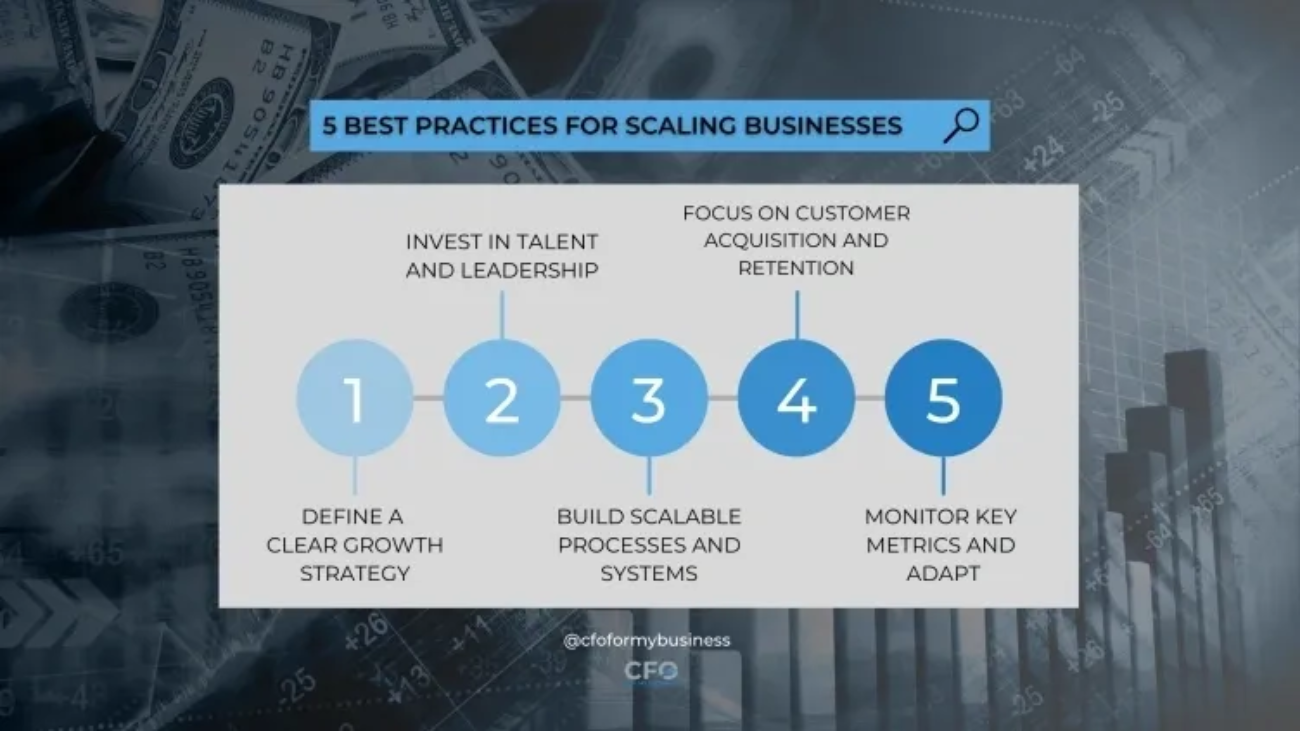
Unlocking Business Growth: 5 Best Practices for Scaling Success

As a fractional CFO, I have had the privilege of working with numerous business owners and CEOs on scaling their businesses for long-term growth and success. Scaling a business requires careful planning, strategic decision-making, and a focus on key practices that drive sustainable expansion. In this article, I will share five best practices that I have found to be instrumental in scaling businesses effectively.


**1. Define a Clear Growth Strategy**

Scaling a business without a well-defined growth strategy is like setting sail without a destination in mind. It is crucial to establish a clear vision of where you want your business to go and create a roadmap to get there. Consider the following steps:

– Conduct a comprehensive analysis of your industry, market trends, and competitive landscape.

– Identify new growth opportunities, target markets, and customer segments.

– Set specific, measurable, achievable, relevant, and time-bound (SMART) goals to guide your scaling efforts.

– Develop a detailed plan outlining the necessary actions, resources, and milestones to achieve your growth objectives.


**2. Invest in Talent and Leadership**

A successful scale-up requires a capable and motivated team. Invest in hiring and retaining top talent to fuel your growth. Consider these practices:

– Define clear job descriptions and competency requirements for each role.

– Recruit individuals who align with your company culture and values.

– Provide ongoing training and development opportunities to enhance skills and knowledge.

– Establish effective leadership practices to empower and inspire your team.

– Foster a collaborative and inclusive work environment that encourages innovation and creativity.


**3. Build Scalable Processes and Systems**

As your business grows, the processes and systems you have in place must be able to scale with it. Streamline operations and ensure efficiency by:

– Documenting and standardizing key processes to create consistency.

– Implementing technology solutions that automate and optimize workflows.

– Regularly reviewing and refining your processes to eliminate bottlenecks and inefficiencies.

– Developing a scalable infrastructure that can support increased demand and future growth.


**4. Focus on Customer Acquisition and Retention**

Scaling a business is not just about acquiring new customers; it also involves retaining existing ones. Prioritize customer acquisition and retention strategies by:

– Identifying your ideal customer profile and targeting your marketing efforts accordingly.

– Implementing a robust lead generation and nurturing process.

– Providing exceptional customer experiences to build loyalty and advocacy.

– Actively seeking customer feedback and using it to improve your products or services.

– Developing customer retention initiatives such as loyalty programs or personalized offers.


**5. Monitor Key Metrics and Adapt**

To successfully scale your business, you need to monitor key performance indicators (KPIs) and adapt your strategies accordingly. Consider the following practices:

– Identify and track relevant KPIs that align with your growth objectives.

– Establish a regular reporting and review process to monitor progress.

– Analyze data and metrics to gain insights into areas of improvement or potential risks.

– Stay agile and be willing to adjust your strategies based on market changes or emerging trends.

– Foster a culture of continuous improvement and learning within your organization.


In conclusion, scaling your business requires strategic planning, diligent execution, and a commitment to continuous improvement. By implementing the five best practices outlined in this article – with the guidance and expertise of a fractional CFO – you can position your business for long-term success.

A fractional CFO can provide invaluable insights and financial expertise to support your scaling efforts. Their strategic guidance can help you develop a clear growth strategy, optimize your financial processes, and make data-driven decisions. Consider partnering with a fractional CFO to maximize the effectiveness of these best practices and accelerate your scaling journey.

Remember, scaling is a journey, and success is not achieved overnight. Embrace these practices with the assistance of a fractional CFO as your trusted advisor. By consistently applying these best practices and leveraging the expertise of a CFO, you can set yourself on the path to sustainable growth and expansion.


🚀Ready to scale your business for long-term success?📊

As a fractional CFO, I’m here to guide you through the process and help you achieve your growth objectives. Let’s work together to define a clear growth strategy, invest in top talent, build scalable processes, prioritize customer acquisition and retention, and monitor key metrics for continuous improvement.

Reach out today for a FREE 30-minute strategy call and start your journey towards scaling your business effectively. Your success awaits!

📞(602) 832-7070

Ron Elwood, CFO For My Business

Let’s take your business to new heights!🔝

#ScaleYourBusiness #FractionalCFO #BusinessGrowth #SustainableSuccess#cfoformybusiness

Wishing you all the best on your scaling journey!


If you found this article helpful, share your thoughts and experiences in the comments below, and feel free to reach out if you have any questions or need further guidance.