
Guide to Fractional CFO Services for Startups and Growing Companies

How to Write a Business Plan: 10-Step Framework

How to Write a Business Plan: 10-Step Framework for Success
📌 SUMMARY: A business plan is your roadmap to success. This 10-step framework guides you from executive summary to financial projections, helping you clarify strategy, attract investors, and avoid common pitfalls. Packed with actionable templates, burn rate insights, and expert CFO tips.

How to Write a Business Plan: 10-Step Framework

Writing a business plan can feel overwhelming, but it’s one of the most powerful things you can do for your venture. Whether you’re seeking funding, aligning your team, or stress-testing your idea, a solid plan provides clarity and direction. In this guide, we break it down into 10 logical steps—each with practical advice and real-world examples from our work with technology startups and professional service firms.

A great business plan tells a compelling story about your market opportunity, your unique solution, and your ability to execute. It’s not just a document for bankers; it’s a strategic tool. We’ve helped dozens of businesses at CFO for my Business refine their plans, and these 10 steps incorporate the financial rigor that investors expect.

From defining your value proposition to building realistic financial models, this framework integrates concepts like cash flow optimization, 13-week forecasting, and burn rate management—critical elements for startups and scale-ups. Let’s dive into the blueprint.

📞 Ready to build a bulletproof business plan?

Speak with a fractional CFO who’s guided 100+ businesses.

📱 (602) 832-7070 ✉️ ron@cfoformybusiness.com
📅 Book your 30-min strategy session

1. Executive Summary: The Elevator Pitch

Though it appears first, write this last. Summarize your vision, mission, key financials, and what you’re asking for. Investors often read this to decide if they’ll dive deeper. Keep it to one or two pages, and include your unique value proposition and highlights from each subsequent section.

Example: “ABC Tech is a B2B SaaS platform that reduces warehouse mis-picks by 40%. With $1.2M ARR and 98% gross retention, we seek $2M to expand into the EU market.”

2. Company Description: Who You Are & Why It Matters

Detail your business structure, the problem you solve, and your target market. Include your competitive advantages—proprietary tech, partnerships, or industry expertise. This section sets the stage for everything that follows.

3. Market Analysis: Size, Trends & Opportunity

Use data to demonstrate demand. Define your Total Addressable Market (TAM), Serviceable Addressable Market (SAM), and Share of Market (SOM). Include a competitive landscape table like the one below, which is a staple in solid business plans.

CompetitorMarket ShareStrengthWeakness
Competitor A34%Brand recognitionHigh price, slow support
Competitor B22%Low costLimited features
Your Company8% (growing)AI personalizationNew entrant

4. Products & Services: Solving the Pain Point

Describe your offering in detail. What makes it sticky? For SaaS, include your tech stack, product roadmap, and IP. For services, explain your delivery model. Link to fractional CFO for tech startups to show how financial leadership enhances product-market fit.

📊 Milestone Timeline (Next 18 Months)

MVP launch
Q2 2025
First 100 customers
Q3 2025
Series A ready
Q1 2026
Cash flow positive
Q3 2026

5. Marketing & Sales: Go-to-Market Strategy

Outline channels, customer acquisition cost (CAC), and sales cycle. Use the LTV:CAC ratio—investors love this. A healthy SaaS ratio is >3x. For a deeper dive on avoiding mistakes, read Cash Flow Management Mistakes.

6. Management Team: The People Behind the Plan

Highlight founders, advisors, and key hires. Emphasize industry experience and past exits. If you lack a full-time CFO, mention your part-time CFO for SaaS to build credibility.

7. Financial Projections: The Numbers That Matter

Include P&L, balance sheet, and cash flow statement for 3-5 years. Show assumptions. Below is a simplified revenue forecast.

YearRevenueCOGSGross MarginOpExNet Income
Year 1$500k$120k76%$450k($70k)
Year 2$1.2M$250k79%$950k$0
Year 3$2.5M$475k81%$1.6M$425k

For a guide on forecasting, see How to Create a 13-Week Cash Flow Forecast.

8. Funding Request: How Much & When

State the amount, use of funds (product dev, sales, working capital), and runway you expect. For startups, this ties directly to burn rate. Learn more about managing burn at Technology Startup Fractional CFO.

MetricYear 1Year 2Comments
Gross Burn$80k/mo$95k/moIncludes R&D + G&A
Net Burn$60k/mo$30k/moImproving with revenue
Runway (months)1428 (if no raise)Based on current cash

9. Cash Flow & Runway Management

Explain your approach to managing liquidity. Investors want to see you understand cash conversion. Include a chart of monthly cash balance. Highlight strategies like vendor negotiation or cash flow optimization. If you're a professional services firm, check specific cash flow tactics.

10. Appendix: Supporting Documents

Attach resumes, product images, technical diagrams, market studies, or letters of intent. Also include detailed financial model outputs. For guidance, why financial modeling is critical in 2026.

✅ Need help finalizing your plan?

Our fractional CFOs specialize in business plans that win investors.

📞 (602) 832-7070 ✉️ ron@cfoformybusiness.com
📅 Meet Ron for a plan review

❓ Frequently Asked Questions

1. How long should a business plan be?

For most startups, 15–25 pages is ideal. It should be long enough to cover all key areas but concise enough to hold attention. The appendix can hold extra data. Always tailor to your audience: investors prefer focused plans with clear financials.

2. What's the difference between a traditional and lean business plan?

A traditional plan is comprehensive, with full sections and detailed financials. A lean plan focuses on key elements (value prop, customers, revenue) and is often just one page. Use lean for internal validation; use traditional for bank loans or serious fundraising.

3. How often should I update my business plan?

At least annually, or whenever you hit major milestones (new funding, product launch, market shift). The financial forecast should be updated monthly, especially the 13-week cash flow. It's a living document.

4. Do I need a CFO to write a business plan?

Not necessarily, but financial projections are the trickiest part. A fractional CFO ensures your numbers are credible and your assumptions are realistic—investors spot weak financials instantly.

5. What are the top 3 mistakes in business plans?

Overly optimistic revenue, ignoring competition, and vague use of funds. Also, many forget to link the plan to cash flow—see common cash flow mistakes to avoid them.

rs=w_1280 (1)

The Rise of Fractional CFOs: Why Your Business Needs One

In the dynamic realm of modern business, the pursuit of innovation and efficiency while minimizing expenditure is a constant endeavor. An emerging and transformative trend is the adoption of Fractional Chief Financial Officers (CFOs) by enterprises, replacing the conventional full-time CFO approach. This transformation is underpinned by a host of compelling factors, substantiated by research, empirical data, and real-world achievements. In the following sections, we delve into the advantages of incorporating a Fractional CFO and elucidate its pivotal role in contemporary business strategies.

Cost-Effectiveness: Elevating Financial Management

In the context of small and medium-sized businesses, engaging a full-time CFO can exert substantial financial strain. Conversely, embracing the Fractional CFO model empowers businesses to harness elite financial acumen sans the fiscal burden of a full-time executive. Recent surveys underscore the efficacy of this approach, revealing operational cost savings of up to 40% following the transition to Fractional CFOs.

Access to Specialized Expertise: Profound Expertise, Tailored Insights

Fractional CFOs, distinguished financial practitioners, bring a reservoir of experience and expertise to the forefront. By enlisting their services, enterprises gain access to a multifaceted skill set honed across diverse industries. This fosters the utilization of specialized insights, facilitating judicious financial decisions that can steer businesses towards optimal trajectories.

Flexibility and Scalability: Adapting to Change

The business landscape is marked by dynamism, subject to fluctuations tethered to market dynamics. Embracing the Fractional CFO paradigm endows businesses with the ability to recalibrate financial support in real time, seamlessly accommodating shifts in requirements. This adaptability proves invaluable during phases of expansion, mergers, or economic uncertainties.

Objectivity and Unbiased Advice: Informed Counsel

Fractional CFOs epitomize impartiality, evaluating financial strategies from an objective vantage point. This detachment, devoid of internal biases or organizational politics, fuels innovative problem-solving and equips enterprises to navigate challenges astutely.

Focus on Core Business Functions: Unleashed Potential

Successful business operation demands an unwavering focus on core functions and strategic advancement. By enlisting Fractional CFOs, intricate financial intricacies can be entrusted to adept professionals, enabling business leaders to channel their energies towards core competencies.

Improved Financial Reporting: Insights Beyond Numbers

Comprehensive financial reporting is essential for informed decision-making. Research by EY highlights that Fractional CFOs are adept at generating detailed financial reports that offer clear insights into a company’s performance. These reports empower businesses to optimize their financial operations and identify areas for improvement.

Risk Mitigation: A Compliance Advantage

Fractional CFOs are well-versed in navigating complex financial regulations and compliance requirements. According to PwC, an increasing number of businesses are turning to Fractional CFOs to mitigate risks associated with financial compliance, safeguarding the company from potential penalties and reputational damage. Within the tapestry of business, adherence to financial regulations and risk mitigation loom large. Fractional CFOs, armed with extensive regulatory insight, mitigate the specter of non-compliance and associated penalties.

Seamless Integration: Navigating Change with Finesse

Conversely to concerns, integrating a Fractional CFO is characterized by a seamless onboarding process. These professionals expediently familiarize themselves with an organization’s structure, systems, and objectives, delivering uninterrupted financial guidance.

Conclusion: Embrace Excellence in Financial Management

Transitioning to the agile Fractional CFO model signifies a strategic shift in financial management, backed by real-world successes and industry insights. This model offers a streamlined approach, reducing costs linked to full-time executives and allowing businesses to focus on core operations and strategic initiatives.

Fractional CFOs bring indispensable specialized expertise, guiding businesses toward informed financial decisions and innovative solutions. Their flexible and scalable approach enables adaptability to evolving market dynamics, ensuring prosperity even during growth phases, economic shifts, or strategic pivots.

By embracing the Fractional CFO model, businesses can channel their focus away from intricate financial details, concentrating instead on core operations and strategic expansions. This aligns with the trend of outsourcing specialized functions, freeing leaders to concentrate on growth-driving and innovative sectors.

In essence, the Fractional CFO model represents a strategic stance that redefines financial management. By leveraging cost savings, specialized expertise, adaptability, and enhanced financial reporting, businesses position themselves for growth and success in an ever-evolving landscape. The Fractional CFO model encapsulates the essence of future financial leadership, providing businesses a competitive edge and the tools to navigate intricate financial landscapes with confidence.

rs=w_1280

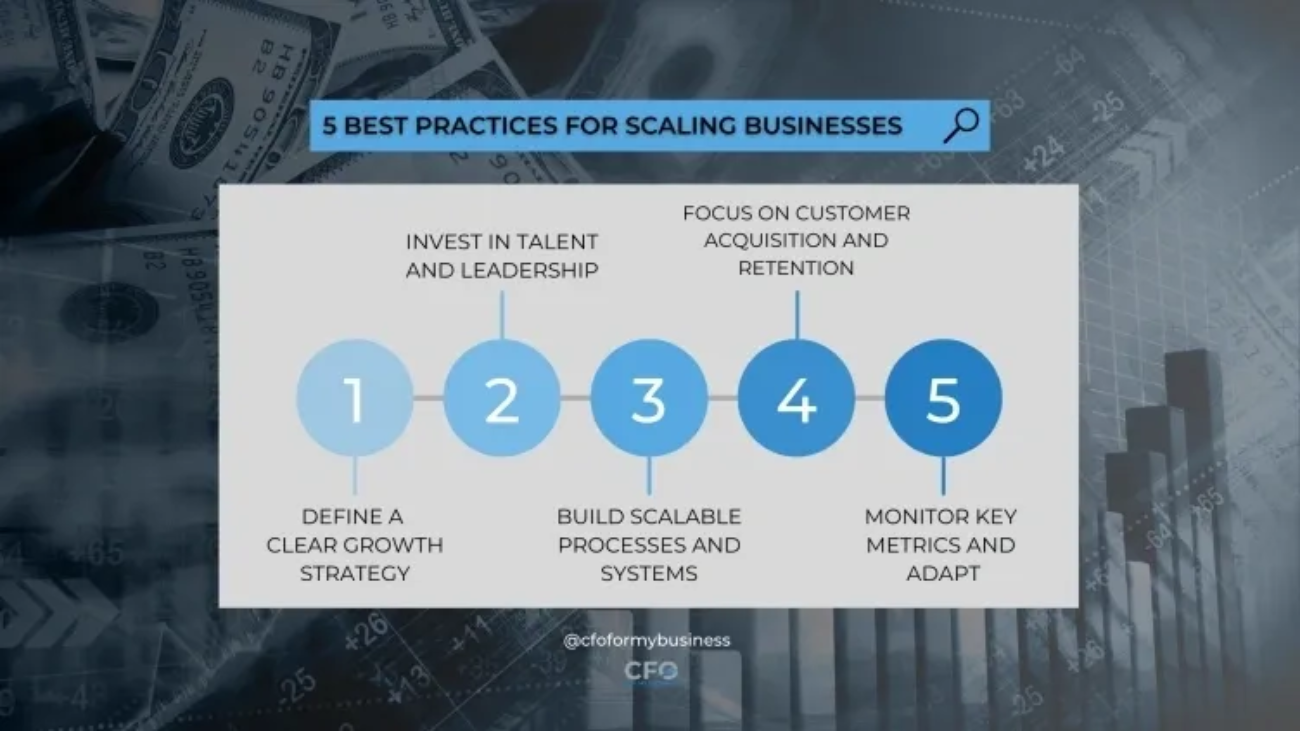
Unlocking Business Growth: 5 Best Practices for Scaling Success

As a fractional CFO, I have had the privilege of working with numerous business owners and CEOs on scaling their businesses for long-term growth and success. Scaling a business requires careful planning, strategic decision-making, and a focus on key practices that drive sustainable expansion. In this article, I will share five best practices that I have found to be instrumental in scaling businesses effectively.


**1. Define a Clear Growth Strategy**

Scaling a business without a well-defined growth strategy is like setting sail without a destination in mind. It is crucial to establish a clear vision of where you want your business to go and create a roadmap to get there. Consider the following steps:

– Conduct a comprehensive analysis of your industry, market trends, and competitive landscape.

– Identify new growth opportunities, target markets, and customer segments.

– Set specific, measurable, achievable, relevant, and time-bound (SMART) goals to guide your scaling efforts.

– Develop a detailed plan outlining the necessary actions, resources, and milestones to achieve your growth objectives.


**2. Invest in Talent and Leadership**

A successful scale-up requires a capable and motivated team. Invest in hiring and retaining top talent to fuel your growth. Consider these practices:

– Define clear job descriptions and competency requirements for each role.

– Recruit individuals who align with your company culture and values.

– Provide ongoing training and development opportunities to enhance skills and knowledge.

– Establish effective leadership practices to empower and inspire your team.

– Foster a collaborative and inclusive work environment that encourages innovation and creativity.


**3. Build Scalable Processes and Systems**

As your business grows, the processes and systems you have in place must be able to scale with it. Streamline operations and ensure efficiency by:

– Documenting and standardizing key processes to create consistency.

– Implementing technology solutions that automate and optimize workflows.

– Regularly reviewing and refining your processes to eliminate bottlenecks and inefficiencies.

– Developing a scalable infrastructure that can support increased demand and future growth.


**4. Focus on Customer Acquisition and Retention**

Scaling a business is not just about acquiring new customers; it also involves retaining existing ones. Prioritize customer acquisition and retention strategies by:

– Identifying your ideal customer profile and targeting your marketing efforts accordingly.

– Implementing a robust lead generation and nurturing process.

– Providing exceptional customer experiences to build loyalty and advocacy.

– Actively seeking customer feedback and using it to improve your products or services.

– Developing customer retention initiatives such as loyalty programs or personalized offers.


**5. Monitor Key Metrics and Adapt**

To successfully scale your business, you need to monitor key performance indicators (KPIs) and adapt your strategies accordingly. Consider the following practices:

– Identify and track relevant KPIs that align with your growth objectives.

– Establish a regular reporting and review process to monitor progress.

– Analyze data and metrics to gain insights into areas of improvement or potential risks.

– Stay agile and be willing to adjust your strategies based on market changes or emerging trends.

– Foster a culture of continuous improvement and learning within your organization.


In conclusion, scaling your business requires strategic planning, diligent execution, and a commitment to continuous improvement. By implementing the five best practices outlined in this article – with the guidance and expertise of a fractional CFO – you can position your business for long-term success.

A fractional CFO can provide invaluable insights and financial expertise to support your scaling efforts. Their strategic guidance can help you develop a clear growth strategy, optimize your financial processes, and make data-driven decisions. Consider partnering with a fractional CFO to maximize the effectiveness of these best practices and accelerate your scaling journey.

Remember, scaling is a journey, and success is not achieved overnight. Embrace these practices with the assistance of a fractional CFO as your trusted advisor. By consistently applying these best practices and leveraging the expertise of a CFO, you can set yourself on the path to sustainable growth and expansion.


🚀Ready to scale your business for long-term success?📊

As a fractional CFO, I’m here to guide you through the process and help you achieve your growth objectives. Let’s work together to define a clear growth strategy, invest in top talent, build scalable processes, prioritize customer acquisition and retention, and monitor key metrics for continuous improvement.

Reach out today for a FREE 30-minute strategy call and start your journey towards scaling your business effectively. Your success awaits!

📞(602) 832-7070

Ron Elwood, CFO For My Business

Let’s take your business to new heights!🔝

#ScaleYourBusiness #FractionalCFO #BusinessGrowth #SustainableSuccess#cfoformybusiness

Wishing you all the best on your scaling journey!


If you found this article helpful, share your thoughts and experiences in the comments below, and feel free to reach out if you have any questions or need further guidance.