
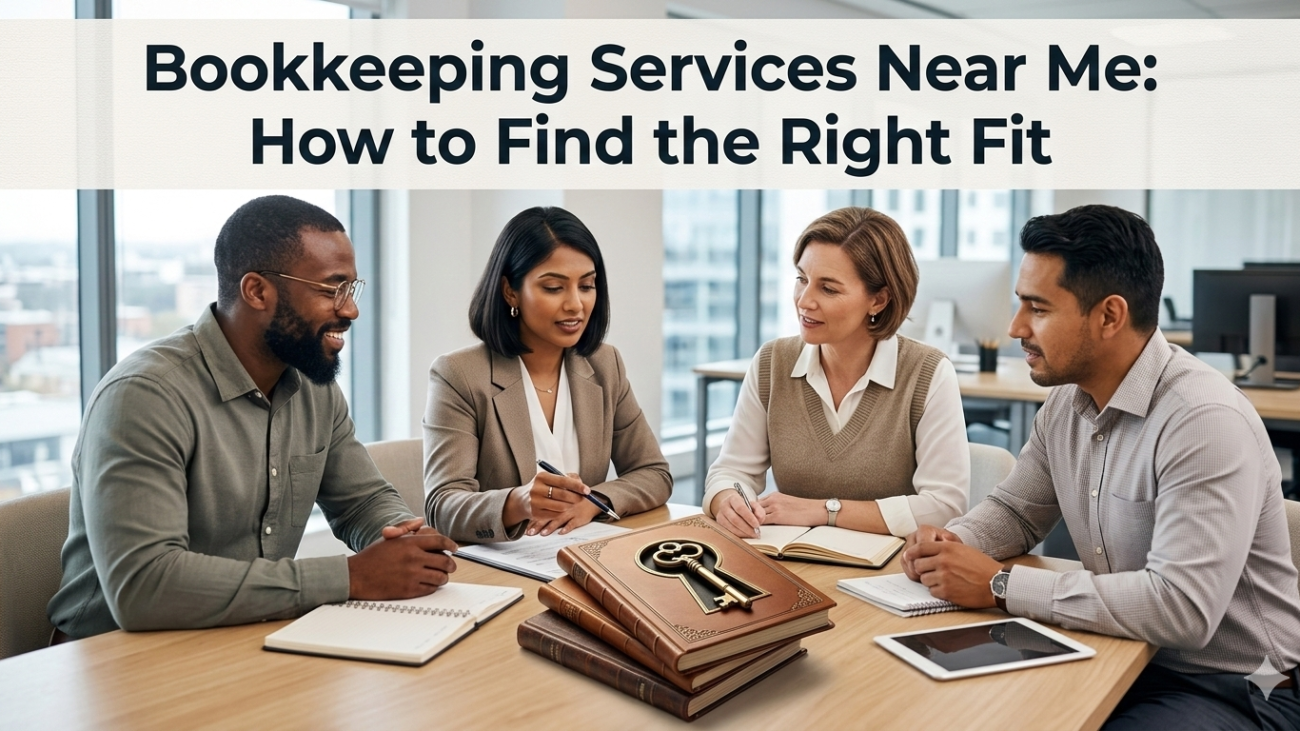
Searching for “bookkeeping services near me”? The perfect fit balances local know-how, industry expertise, and tech compatibility. In this guide you’ll discover how to compare in-house, freelance, and virtual bookkeepers, which questions to ask, and warning signs to avoid – so your financial records are always accurate and stress-free.
📖 Table of Contents
1. Why quality bookkeeping is non‑negotiable
Accurate bookkeeping is the bedrock of financial clarity. Without it, you’re flying blind: cash flow gets murky, tax deductions slip away, and investors lose confidence. A local bookkeeper who understands your market can be a strategic partner – not just a data entry person. Yet with so many options, finding “bookkeeping services near me” that truly fit your business size, industry, and style takes more than a quick Google search.
Many owners assume a nearby bookkeeper means easier communication, but virtual specialists often bring niche expertise (like e‑commerce or construction). The key is aligning their strengths with your specific pain points. For example, if your cash flow fluctuates wildly, you need someone who excels at cash flow optimization and can flag trouble early.
Statistics show that 60% of small business owners feel they lack financial understanding – and poor bookkeeping is a top reason for failure. That’s why a tailored search matters. Below we break down every angle so you can decide with confidence.
📞 Need a personalized recommendation? Talk to Ron today.
2. Types of bookkeeping services: local, virtual, freelance & firms
When you look for “bookkeeping near me”, you’ll typically find four categories. Each has distinct trade-offs.
- Freelance bookkeepers – often affordable, flexible, but may lack backup or deep bench.
- Local boutique firms – hands‑on, industry connections, but possibly higher rates.
- Virtual/cloud services – scalable, tech‑forward, yet you might miss face‑to‑face rapport.
- In‑house employee – total control, but expensive and hard to find right talent.
Multi‑location businesses or those preparing for sale often need more robust support. For them, we have specific resources: cash flow strategies when selling and multi‑location cash flow.
3. Key factors to find “the right fit” near you
Don’t just pick the first name on Google Maps. Evaluate these dimensions:
Retail, construction, nonprofit?
QuickBooks, Xero, or custom ERP?
Weekly, monthly, or real‑time?
Local testimonials matter
If you’re a professional services firm, your needs differ from a product‑based business. Read our deep dive on cash flow for professional services firms.
4. Five questions you must ask a prospective bookkeeper
- “Which financial reports will you prepare monthly?” (P&L, balance sheet, cash flow)
- “How do you handle sales tax and payroll?”
- “What’s your turnaround time for closing the books?”
- “Do you have experience with [your industry]?”
- “Can you share two client references (preferably local)?”
Asking these upfront prevents mismatched expectations. Also check if they collaborate with your tax accountant – a seamless link can save thousands. For deeper insight, explore common cash flow mistakes to see how bookkeeping ties into those pitfalls.
5. Red flags that scream “keep looking”
- 🚩 Vague about pricing or asks for long‑term contract immediately.
- 🚩 No clear data backup policy or uses outdated spreadsheets.
- 🚩 Unwilling to provide references or proof of certification.
- 🚩 Doesn’t ask about your business – a one‑size‑fits‑all approach rarely works.
6. Comparison table: bookkeeping service types
| Type | Avg monthly cost | Best for | Drawbacks |
|---|---|---|---|
| Freelance | $300 – $800 | Startups, micro‑businesses | Single point of failure |
| Local firm | $800 – $2,500 | Established SMBs, local compliance help | May be less tech‑savvy |
| Virtual service | $500 – $1,500 | Remote teams, scalability | No in‑person meetings |
| In‑house employee | $3,500+ (salary+taxes) | High‑volume transaction businesses | Benefits, overhead, training |
To forecast your cash flow with any of these options, learn how to build a 13‑week cash flow forecast — it’s a game changer for visibility.
7. Cost vs. value: don’t just pick the cheapest
Low‑cost bookkeepers might miss deductions or misclassify expenses, costing you more later. Consider value: a proactive bookkeeper helps you claim R&D tax credits (see R&D tax credits), catch billing errors, and optimize working capital. One that integrates with your financial modeling tools can also feed directly into your strategic plan.
8. Technology & integration: the modern must‑have
Your bookkeeper should be fluent in cloud platforms. Ask if they use receipt‑scanning apps, auto‑reconciliation, and real‑time dashboards. Seamless integration with your business plan (like how to write a business plan) and forecasting tools ensures you’re not just recording history but building future strategy.
📌 Want a trusted partner who understands your numbers?
Ron Elwood and the CFO for my business team offer fractional CFO support and can connect you with vetted bookkeeping pros. Call or email today:
📞 (602) 832-7070 ✉️ ron@cfoformybusiness.com
📅 Book your free consultation9. How CFO for my business bridges the gap
We don’t just offer bookkeeping – we elevate it. Whether you need a local bookkeeper referral, cash flow strategy, or advanced modeling, our network blends local presence with high‑level financial leadership. We’ve helped businesses like yours optimize cash flow, avoid pitfalls, and prepare for growth. Check out our dedicated articles on cash flow optimization and financial modeling tools to see how we think.
🙋 Frequently Asked Questions
🚀 Ready to find your ideal bookkeeping fit? Let’s talk.
CFO for my business — local financial leadership, without the full‑time cost.